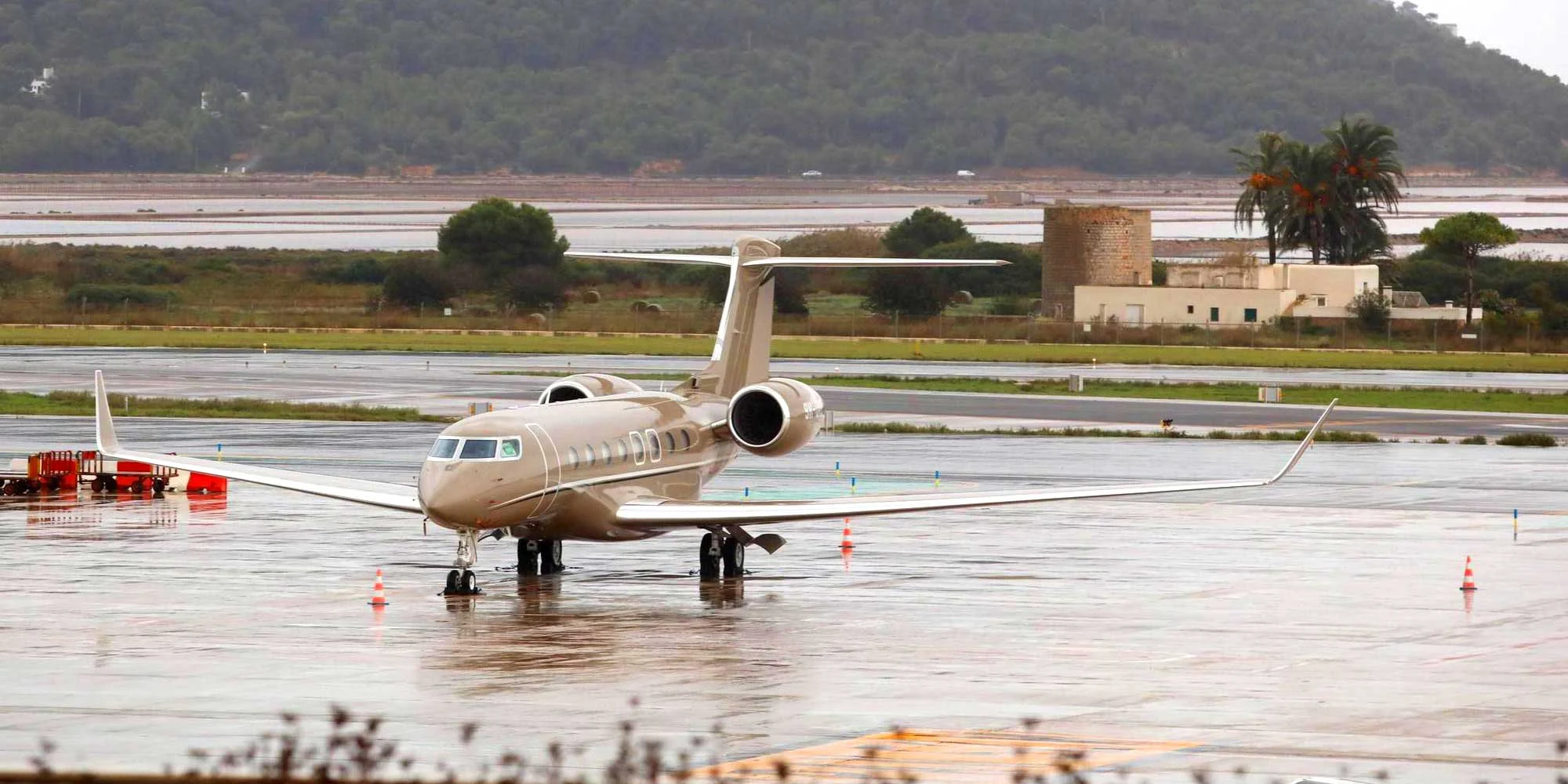
The Spanish Senate’s Transport and Sustainable Mobility Committee has approved a motion introduced by Ibiza and Formentera Senator Juanjo Ferrer aimed at implementing measures at both the national and European Union levels to ensure that private jet fuel is taxed in the same way as other privately used fuels.
The proposal also seeks to prioritize commercial aviation over private jet traffic, particularly when allocating airport slots and managing other operational airport constraints. The initiative reflects growing concerns about the environmental impact of private aviation and the need for more equitable transportation policies.
Ibiza Airport Among Europe’s Busiest for Private Jets
During the debate, Ferrer argued that private jets represent “the most polluting form of transport, the most energy-intensive, and the least equitable in terms of passengers transported per kilometer.” He also described the sector as a privileged industry where social inequalities are particularly visible.
The senator highlighted that Ibiza Airport handles more private jet traffic than any other airport in Spain, surpassing both Barcelona and Madrid. It currently ranks as the eighth busiest airport in Europe for private jet operations.
Private Jets Emit 14 Times More CO₂ Than Commercial Flights
According to Ferrer, although private aviation emissions account for only between 2% and 4% of total aviation emissions worldwide during the 2012–2023 period, the environmental impact per passenger is significantly higher.
“Private aircraft emit an average of two tonnes of CO₂ per hour, which is approximately 14 times more than a standard commercial flight and 50 times more than rail transport,” he stated.

Growing Debate Over Aviation Fuel Tax Exemptions
Across the European Union, aviation fuel (kerosene) used on international flights has traditionally been exempt from excise duties on hydrocarbons due to long-standing international agreements.
However, the approved motion notes that there has been increasing political and environmental debate in recent years over whether such tax exemptions should continue, especially for private jets, given their disproportionately high carbon footprint per passenger.
Climate Change Impacts on the Balearic Islands
Ferrer also emphasized that global warming and climate change are having particularly severe consequences for island territories such as Ibiza and Formentera. He referenced recent extreme weather events, including severe autumn storms and recurring summer heatwaves affecting the Balearic Islands.
According to Greenpeace, citing a 2024 study by the Balearic Oceanographic Centre of the Spanish Institute of Oceanography, the total land area of Formentera could be significantly reduced in the coming decades due to the effects of sea-level rise and climate change, with other parts of the Balearic archipelago facing similar risks.
Motion Approved with Cross-Party Support
The motion was approved with votes in favor from Esquerra Confederal and the Basque Nationalist Party (PNV), while both the Spanish Socialist Workers’ Party (PSOE) and the People’s Party (PP) abstained.
The proposal adds momentum to the broader European discussion surrounding sustainable aviation, private jet regulation, aviation fuel taxation, and strategies to reduce greenhouse gas emissions from air transport.