The €98,672 restoration project was delayed by an unsuccessful tender and the difficulty of sourcing custom-made marès stone blocks needed to rebuild the historic walls.
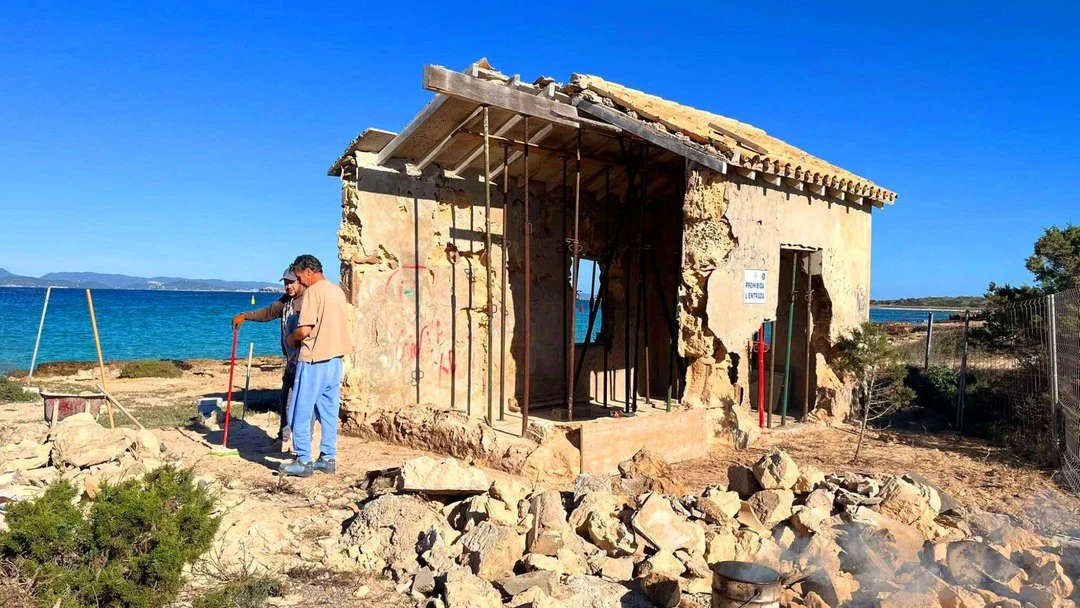
Restoration work has begun on Casa des Telègraf, a historic building in Formentera located next to the Mollet d’en Guasch and Sa Sequi, near La Savina, following several delays. Dating back to the early 20th century, the property forms part of the Ses Salines complex, which is protected as a Site of Cultural Interest (BIC). The project aims to restore the building to its original appearance after years of deterioration.
According to the Formentera Island Council (Consell Insular), the initial tender attracted no bids, forcing the authorities to use a negotiated procedure to award the contract. Once the agreement had been signed, the work was delayed again because custom-sized marès limestone blocks had to be specially manufactured to rebuild the walls. Restoration is expected to continue until April 2027.
The contract was awarded in February to Urbanizaciones Formentera SL for €98,672.27, including VAT, after the tender launched in September 2025 received no offers. The project is being funded through the EU’s Next Generation funds, under the Sustainable Tourism Destinations Plan.
The architectural report, prepared by Villafranca i Serra Arquitectes and updated in 2024, states that the original walls were built using marès stone blocks measuring 58 by 48 by 28 centimetres. The restoration will respect the building’s original materials, volume and appearance, preserving the sections that remain standing and rebuilding those that have disappeared using traditional techniques.
Exposed to the elements
The small building has a total floor area of 24.24 square metres, including 18.24 square metres of usable interior space. It stands within Ses Salines Natural Park, between the sea and s’Estany Pudent.
Its proximity to the coast leaves it exposed to strong winds, humidity and sea spray, all of which have contributed to its deterioration. The damage has also been compounded by storms associated with danas — severe weather systems that bring intense rainfall and strong winds — which have affected the Pitiusas islands over the past three years.
The building stands approximately 25 metres from the coastline, next to Sa Guia, the path that follows the former route of the island’s salt railway.
Listed in Formentera’s Cultural Heritage Catalogue with the highest level of protection, the building suffered the collapse of one corner and part of its southern façade in 2014. Emergency supports had to be installed beneath the roof to prevent the structure from collapsing completely. Since then, it has remained propped up and enclosed by a protective fence.
Plans for future public use
The restoration will repair the walls and renderings and reconstruct the building’s pitched wooden roof. The project aims to reuse between 70% and 80% of the original roof tiles, provided they are still in suitable condition. The existing flooring will also be preserved, while traditional-style doors and windows will be installed.
The interior will remain a single open space, intended for future public use linked to the island’s heritage and natural surroundings.
The building that connected Formentera to the outside world
Casa des Telègraf is a reminder of the arrival of telecommunications in Formentera.
According to the historical report, a submarine telegraph cable linking Formentera with Ibiza was laid in 1923. Ibiza had already been connected to Mallorca and mainland Spain since the 19th century.
The cable reached Formentera from Ses Salines in Ibiza, with the submarine connection linking up at this small building to an overland line leading to the telegraph office in Sant Francesc. The connection significantly improved communications on an island that had previously remained outside the telegraph network.
The Consell Insular commissioned the restoration project in 2012, but the building’s deteriorating condition and rising costs made a revision necessary in 2024. The updated project was approved in 2025 and, following the difficulties with the tender process and the supply of materials, restoration work is finally underway.