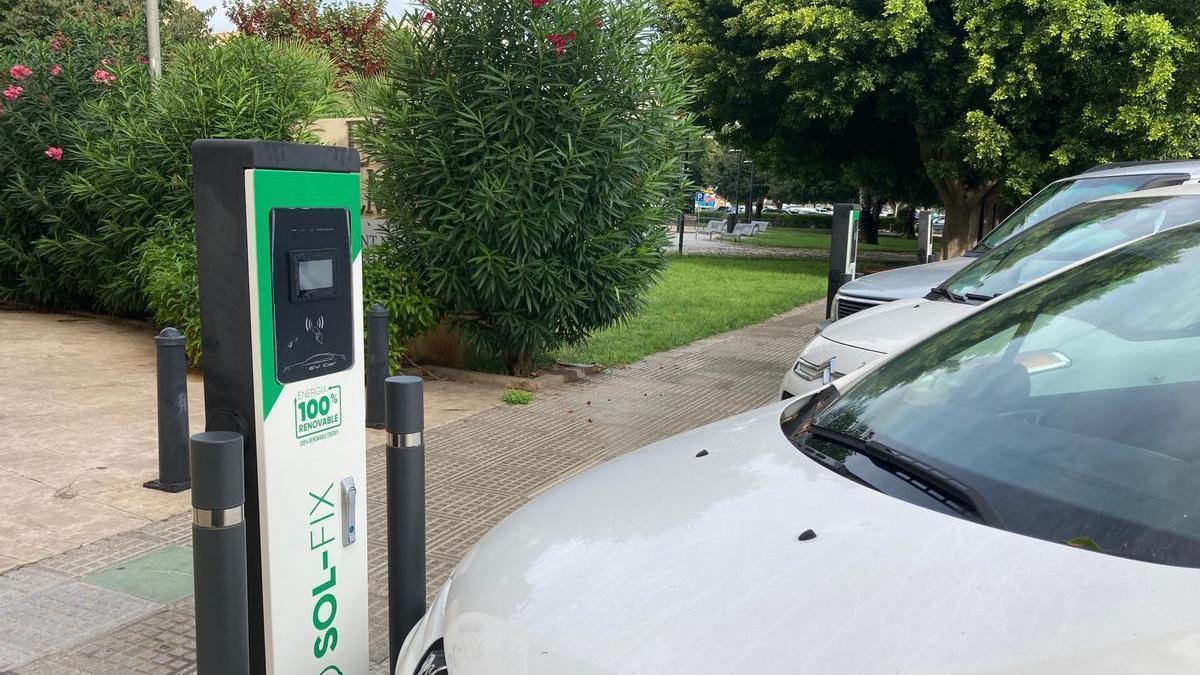
The island’s Melib public charging network covers all five municipalities, while drivers can also install private chargers or explore shared infrastructure in residential garages.
Buying an electric car comes with a practical question: where can you charge it? In Ibiza, drivers can use the public charging network or install a charger at home. For those who park in a shared residential garage, the options include fitting a charger in their own parking space or setting up infrastructure that makes it easier for more residents to connect their vehicles in the future.
Public EV charging points across Ibiza
The Melib public charging network has a presence in all five municipalities of Ibiza, although the number of facilities varies from one area to another.
According to figures from the Balearic Islands regional government, Ibiza Town has 20 chargers and 40 charging connections. Sant Antoni has five chargers and ten connections, while Sant Joan also has five charging points and ten connections.
Sant Josep has 16 chargers and 60 connections, while Santa Eulària has 14 chargers and 29 charging points.
The regional government identifies Sant Joan, Sant Josep and Santa Eulària as the municipalities with the highest levels of availability within Ibiza’s Melib network.
The rollout forms part of the Action Plan to Improve the Public Electric Vehicle Charging Network, a regional initiative that municipalities can join through a voluntary agreement.
Installing a private charger in a residential garage
For drivers who prefer to charge their cars in their own parking space, an individual installation can cost between €1,000 and €2,500.
This estimate covers the wall-mounted charging unit, commonly known as a wallbox, along with the cabling, electrical safety equipment, installation work and the required legalisation.
The final cost depends on several factors, including the distance the cable must run and the complexity of the work. These are general indicative prices, not quotations specific to Ibiza.
A shared pre-installation for the whole building
Another option is to prepare the garage’s electrical infrastructure in advance, allowing each resident to install their own charger when needed.
In a residential building with around 50 property owners, this type of shared pre-installation can cost between €10,000 and €20,000, depending on the complexity of the work.
Peio Mendia, treasurer of Spain’s General Council of Associations of Property Administrators, recommends this approach as a way to avoid a patchwork of separate installations.
“We recommend a pre-installation; it is a more orderly solution, because if every resident drills a hole and runs a cable, the garage becomes a tangle of wires,” he told El Periódico.
With shared infrastructure in place, subsequent users can run their cables through the same cable tray. The decision for property owners is whether to address an individual need as it arises or make an upfront investment that will accommodate future connections.
Planning an EV charging installation for the future
Before choosing an installation, residents should check exactly what each quote includes.
Alongside individual chargers and shared pre-installations, some companies offer a different arrangement: they cover the cost of the infrastructure and then charge users for the electricity consumed and a monthly fee.
Any installation must also comply with the applicable technical requirements. Some experts recommend that residential communities check with their insurance provider to ensure their policy offers appropriate coverage.
If an incident occurs, it is important to establish whether the cause lies with the vehicle, the charger or the building’s electrical installation in order to determine any potential liability.
For electric car drivers in Ibiza, the decision starts with a straightforward step: checking which charging options are available near home or work, and how much it would cost to install a charger in their own parking space.