Spain’s convention centres generate an estimated €3.5 billion in economic impact, with 43% benefiting destinations indirectly. Ibiza’s island president, Vicent Marí, says business events can help transform the island and move beyond its party reputation.
Almost half of the economic impact generated by conferences and professional events extends well beyond the venues where they take place. According to preliminary findings from a new measurement tool developed by the Spanish Association of Convention Centres, 42.8% of the €3.5 billion generated by Spain’s convention centre sector comes from indirect economic effects. This represents around €1.5 billion benefiting other sectors, while the remaining €2 billion, or 57.2%, comes from direct impact.
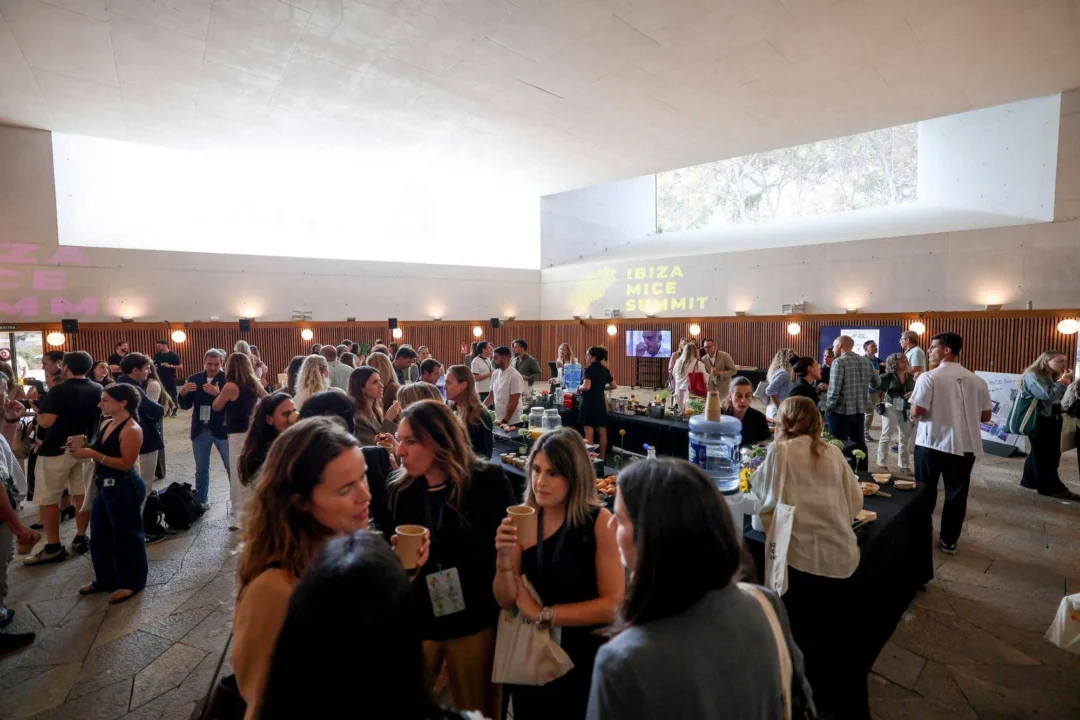
The figures were unveiled on Friday at the sixth Ibiza MICE Summit, held at the Santa Eulària Convention Centre. The new tool is designed to provide a clearer picture of the economic contribution made by meetings, conferences and professional events.
The results give fresh weight to an industry seeking to demonstrate its ability to generate wealth, attract higher-spending visitors and leave lasting benefits in the destinations that host its events.
“That’s the key to our sector. We’re the tourism industry’s golden children because we generate an impact up to four times greater than leisure tourism,” said Sylvia Andrés, president of the Spanish Association of Convention Centres, during the presentation. Carolina García, director of Barcelona’s International Convention Centre (CCIB), also took part.
The comparison is supported by indicators showing an average economic impact of around €800,000 per event and daily spending of between €300 and €400 per attendee. According to the sector’s representatives, these figures help illustrate the importance of business events and give public authorities measurable evidence to support investment in attracting conferences and conventions.
The results have also been compared with figures from other countries. The participating Spanish venues reported a combined economic impact of €3.5 billion. Mexico, with 52 convention centres, recorded around €2 billion, with an average impact of €79,000 per event. Canada, with 19 venues, reported €1.9 billion, averaging €216,000 per event.
“With these figures, we’re starting to believe in ourselves”
Sylvia Andrés, president of the Spanish Association of Convention Centres
“With these figures, we’re starting to believe in ourselves,” Andrés said.
Until now, she explained, individual venues had calculated and reported their results using different criteria, making it difficult to build a consistent picture of the sector as a whole.
“Everyone reports their figures in their own way, and that simply cannot continue,” she warned.
The new platform aims to address this fragmentation through a shared methodology and audited data, allowing the sector to assess its economic contribution more consistently.
Measuring the value of the convention industry
Andrés stressed that reliable indicators are particularly important for public authorities investing taxpayers’ money in attracting events. The aim is to help them explain to citizens how public funds are being spent and what benefits those investments generate.
The data will also allow convention centres to demonstrate the economic results of their activities to prospective clients.
An initial joint report has already been prepared. Each participating venue, including the Santa Eulària Convention Centre, is due to receive an individual report with its own results the following week, alongside the overall study.
The initiative has started with 23 of the association’s 37 member convention centres. Andrés acknowledged that some venues remain reluctant to share financial information, even when confidentiality is guaranteed. One of the main concerns is that the results could eventually be used to rank venues against one another.
Vicent Marí: “What isn’t measured cannot be explained”
The need for reliable data was also central to a panel discussion entitled Assessing the Impact of the Events Industry on Destinations.
Taking part was Vicent Marí, president of Ibiza’s island council and of the Spain Convention Bureau. He described MICE tourism — meetings, incentives, conferences and exhibitions — as one of the segments that brings the greatest added value to the tourism industry.
Marí called for better tools to understand its real contribution.
“What isn’t measured cannot be explained or understood. We cannot spend our lives making decisions based on assumptions rather than on what can actually be measured,” he said.
For Marí, however, the assessment should go beyond economic impact to include the legacy events leave behind.
“We need to look not only at the economic impact, but also at the legacy they leave in a destination. We need to consider their social and environmental effects. The social dimension is becoming increasingly important,” he said.
“Without data, we’re working with one hand tied behind our backs,” he added.
An opportunity to transform Ibiza’s tourism model
The island president placed particular emphasis on the role business events could play in shaping Ibiza’s tourism future.
He argued that the sector should be used as a driver of destination improvement and a way to diversify Ibiza’s international image, ensuring that the island is not identified solely with parties.
“It helps transform a destination,” Marí said, adding that this type of tourism “contributes more than it consumes and leaves a positive footprint”.
The argument reflects a broader ambition to develop tourism that delivers value beyond visitor numbers, bringing economic opportunities while contributing to the island’s long-term development.
Measuring the lasting legacy of business events
The Spanish Association of Convention Centres has set 2028 as its target for introducing indicators that also measure the social legacy of events.
The intention is to assess benefits that are considerably harder to quantify, including knowledge transfer, businesses established as a result of professional gatherings and partnerships formed between participants.
Carolina García, director of Barcelona’s International Convention Centre, also stressed that an event’s success cannot be judged solely from the perspective of the venue hosting it.
In her view, one of the strongest indicators of success is whether organisers return. At the Barcelona venue she leads, 58% of events are repeat bookings, a figure she cited as evidence of organiser satisfaction.
She also added a touch of humour by recalling two essentials for any event attendee: “Above all, the Wi-Fi has to work and the catering has to be good.”
Why destination support matters to event organisers
The importance of measuring the attendee experience was also highlighted by Bárbara Agudo, vice-president of MPI Iberian Chapter and chief strategy officer at Inusual Events.
She agreed that one of the clearest signs that a destination has delivered a successful event is when organisers decide to return.
Institutional support, she warned, plays a crucial role in that decision.
“There’s a need to feel supported by the destination. That makes me more likely to recommend some destinations over others. And it’s not because they put money on the table, but because they solve problems,” she explained.