“This is our memories. This is our culture. This is history.”
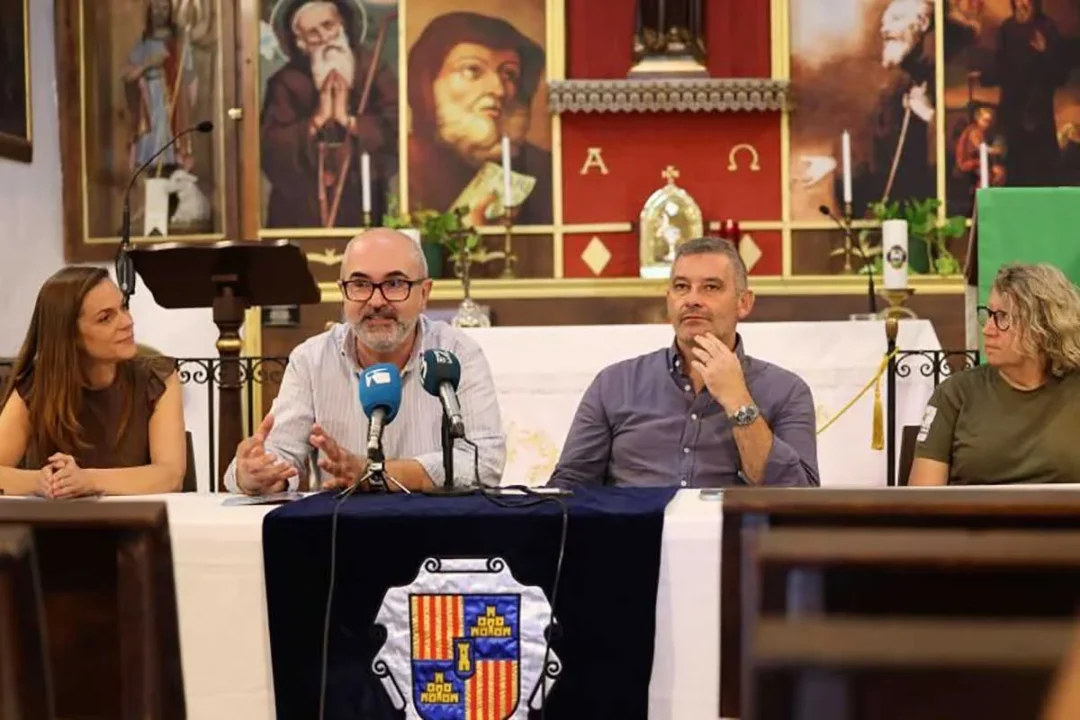
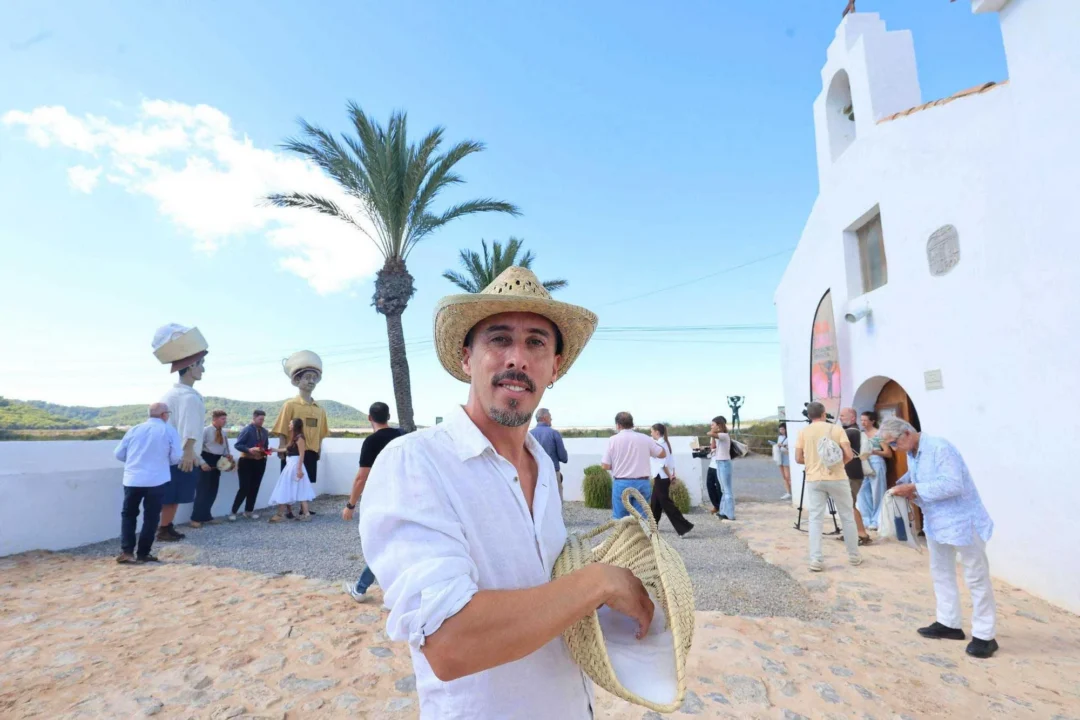
Dressed as one of the traditional salt workers of Ses Salines and carrying a woven esparto-grass basket, actor Miquel Vingut entered the church of Sant Francesc to take visitors on a journey through more than 2,500 years of Ibiza’s salt-making history.
The theatrical performance marked the launch of the 10th Fira de la Sal, which will take place from 16 to 18 October, celebrating a decade of efforts to recover, preserve and pass on the island’s salt-making traditions.
The presentation broke away from the usual press conference format. Following Vingut’s historical performance, Xicu and Jordi appeared, two giant figures that symbolically represent the protectors of salt, accompanied by traditional music from the Grup Folklòric Sant Jordi de Ses Salines.
Standing 2.5 metres tall, the figures are dressed as salt workers from Sant Francesc de s’Estany and Sant Jordi de ses Salines, the two communities historically associated with the industry.
Vingut explained that his character aims to highlight “the importance this place has had for our industry and our island”.
“We have lived off the salt pans for many more centuries than we have lived off anything else,” he said.
His account begins with the Phoenicians, more than 2,500 years ago, and continues through the Roman and Arab periods and into the subsequent Christian era. For centuries, salt was one of Ibiza’s main sources of wealth.
Essential for preserving food and producing salted fish and other preserved products, it also supported commercial exchanges across the Mediterranean. Around the industry, a distinctive way of life developed, shaped by teams of workers, shared knowledge and collective effort.
Preserving the human story behind Ibiza’s salt pans
The presentation also highlighted the people behind this historic industry. Vingut recalled how the physically demanding work of salt harvesting was made more bearable through teamwork, with workers sharing long days, effort and practical knowledge.
This collective memory is one of the key messages the Fira de la Sal hopes to pass on to younger generations.
Ses Salines is not simply one of Ibiza’s most recognisable landscapes. It is also a place of work, community and belonging, shaped by centuries of human activity.
The aim, Vingut explained, is to help people who admire the salt ponds today understand what they represent and the work that has taken place there for generations.
Ten years of bringing Ibiza’s salt-making traditions back to life
Sant Josep mayor Vicente Roig described the tenth edition as proof that the fair has become “a firmly established event” on Ibiza’s calendar.
He said the event is attracting growing interest beyond the island and is increasingly becoming known among tourism operators.
Eva Ruiz, the town council’s tourism coordinator, highlighted how the event has evolved over the past decade.
“What began as a fair celebrating the value of our salt-making past has gradually developed into something focused on documentation, learning and education,” she said.
Nuria Valverde, a technician at Ses Salines Natural Park, also linked the revival of these traditions to the conservation of the protected area. Initiatives of this kind, she explained, help promote cultural heritage without separating it from the natural value of its surroundings.
A new conference explores salt from Ibiza to mainland Spain
This year’s educational programme takes a further step forward with the first-ever mini-conference dedicated to salt.
Entitled ‘Salt of the Earth and Salt of the Sea’, the event will compare Ibiza’s traditional salt-production system, based on evaporating seawater in shallow ponds, with the salt-mining industry of Cardona, a town in Barcelona province invited to participate in this year’s fair.
The programme also includes the launch of a dedicated Fira de la Sal website, where visitors can check the latest schedule, and the distribution of salt-worker kits designed to enrich the visitor experience.
The Salipinta drawing competition will introduce another new feature: a category for participants aged over 18, alongside its existing children’s categories.
Juan Miguel Costa, the island’s director of tourism, stressed the importance of maintaining events once they have been established.
“Getting an event started is always difficult, but making it an established fixture is even harder,” he said.
He also emphasised the importance of ensuring that younger generations understand “what Ibiza was like and what an industry that was essential for many centuries meant to the island”.
Fira de la Sal 2026: Full programme, 16–18 October
The three-day event combines cultural activities, traditional food, workshops and demonstrations of historic salt-harvesting techniques.
Friday, 16 October: Heritage and the history of salt
- 9am–3pm: La Fira de la Sal amb els nostres majors (The Salt Fair with Our Elders), an event aimed at older residents of the municipality.
- 5pm: Live recording of Onda Agraria, the Onda Cero radio programme, at the Sant Jordi multipurpose hall.
- 6.30pm: The first mini-conference, Salt of the Earth and Salt of the Sea, featuring historian Antoni Ferrer Abárzuza, Andreu Galera, director of the Cardona Historical Archive, and José Miguel Marí of Salinera Española, the company responsible for operating Ses Salines.
The opening day focuses on the history of salt production and the cultural links between Ibiza and other salt-producing regions.
Saturday, 17 October: Markets, workshops and traditional Ibizan food
Activities move to Sant Jordi, where visitors can enjoy a full day of family-friendly events, local crafts and gastronomy.
- 10am–5pm: Artisan market.
- 10.30am–12.30pm: Children’s workshops and a painting workshop for adults using salt and textures.
- 10.30am–4pm: Workshop on making aromatic salt.
- 11am–2pm: Food tastings and preparations featuring salt.
- 12 noon: Salipinta drawing competition awards ceremony.
- 12.15pm–12.45pm: Xicu and Jordi parade through the village.
Traditional food and live entertainment
- 12.45pm–2pm: Culinary demonstrations and the return of the traditional ossos amb col, a local dish of pork bones and cabbage prepared with salt from Ses Salines. Each serving costs €5.
- 2pm–4pm: Live music by Maik & Reya.
- 6pm–7pm: A theatrical storytelling performance inspired by the island’s salt-making heritage.
- 7.30pm: The traditional salpassa, a blessing custom involving the use of salt water in homes, is revived.
- 8pm: Solemn Mass at Sant Jordi church.
Saturday’s programme brings together traditional cuisine, local customs and family activities, offering visitors a chance to discover aspects of Ibizan culture beyond its beaches and nightlife.
Sunday, 18 October: Traditional salt harvesting at Ses Salines Natural Park
The final day moves to Ses Salines Natural Park, where the programme focuses on the historic work carried out in the salt pans.
Road traffic will be restricted in the area. Visitors will be able to park at the DC10 car park, from where shuttle minibuses and a small tourist train will operate.
The Sunday programme will revive some of the most symbolic elements of the old salt-harvesting season, including:
- The lighting of the fogueró, the traditional fire used as a signal announcing the start of the salt harvest.
- Manual salt-harvesting demonstrations, recreating traditional techniques.
- The salt workers’ school, offering an introduction to the skills associated with the trade.
- Theatrical guided visits to Torre de la Sal Rossa, bringing the area’s history to life.
These activities offer a closer look at the people, traditions and working methods that shaped Ibiza’s salt industry over the centuries.
For visitors, the final day provides an opportunity to explore the cultural heritage of Ses Salines alongside its distinctive natural landscape.
Discover a different side of Ibiza at the Fira de la Sal
Now in its tenth year, the Fira de la Sal has grown from an event celebrating the island’s salt-making past into a broader programme of cultural documentation, education and heritage preservation.
Taking place from 16 to 18 October 2026, it offers an alternative way to experience Ibiza in autumn, through traditional food, local history, family workshops and demonstrations in one of the island’s most distinctive landscapes.
The fair’s central message remains the same: Ibiza’s salt pans are not just part of the scenery, but a living reminder of the people and industry that helped shape the island.