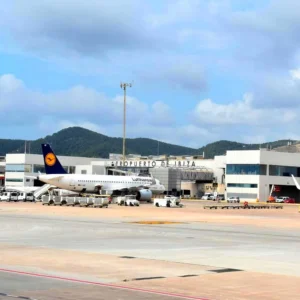
Passenger numbers have climbed from 4.1 million in 2004 to more than 9.1 million in 2025, while airport operator Aena forecasts 9.7 million by 2031.
Tourism has transformed the Balearic Islands dramatically over recent decades. Once a relatively little-known destination, Ibiza and Formentera have become international hotspots welcoming millions of visitors every year. One of the clearest indicators of this transformation is air traffic.
As debate continues over the possible expansion of Ibiza Airport and the island’s ability to cope with growing visitor numbers, the latest figures reveal a sustained upward trend. They also point to a near future in which passenger traffic could exceed expectations, particularly those set out by airport operator Aena.
Between 2004 and 2025, the number of passengers using Ibiza Airport increased by 119.1%, while aircraft movements rose by 74.4%. Annual statistics published by Aena show that the airport has more than doubled its passenger traffic in just 21 years.
In 2004, the airport handled 4,171,580 passengers, compared with 9,138,347 in 2025. This represents an increase of 4,966,767 passengers a year, bringing almost five million additional travellers through the terminal compared with two decades earlier.
Aircraft movements have also increased considerably, although at a slower rate. The figures include both take-offs and landings. In 2004, the airport recorded 48,798 movements, compared with 85,088 last year. That is an additional 36,290 movements, representing growth of 74.4%.
DORA III: Ibiza Airport could approach 10 million passengers by 2031
The gap of almost 45 percentage points between passenger growth and aircraft movements suggests that the number of travellers has increased considerably faster than the number of flights. This could be consistent with the use of larger aircraft, higher passenger occupancy rates, or a combination of both factors.
The long-term trend takes on particular significance in light of the growth forecasts included in DORA III, Spain’s new Airport Regulation Document covering the 2027–2031 period.
As previously reported by Diario de Ibiza, Aena expects Ibiza Airport to handle 9,718,800 passengers by 2031. This forecast could potentially be exceeded and would bring the airport close to its estimated maximum reference capacity of 10 million passengers per year.
If Aena’s projections are met, the airport would handle another 580,453 passengers compared with 2025, representing additional growth of 6.4%. It would then be just 281,200 passengers short of the 10-million annual capacity benchmark.
In fact, the 9.13 million passengers recorded in 2025 already represented 91.4% of that estimated capacity, leaving relatively little room between current traffic levels and the threshold used by Aena.
The major growth surge of 2016
Ibiza Airport’s expansion has not followed a steady upward trajectory. The annual statistics reveal different periods of growth, decline and recovery over the past 21 years.
One of the most significant turning points came in 2016, when passenger numbers jumped by 14.5% in a single year. This was the largest percentage increase recorded during the pre-pandemic period.
The surge marked one of the airport’s fastest periods of expansion. Growth continued over the following years, although at a more moderate pace, until passenger numbers reached 8,155,626 in 2019, the last full year before the Covid-19 crisis.
Earlier periods had also seen substantial increases. In 2010 and 2011, for example, passenger numbers rose by 10.2% and 12%, respectively.
Covid-19 caused a historic collapse in airport traffic
The pandemic brought an unprecedented disruption to the airport’s growth. In 2020, passenger numbers plunged by 74.1% compared with 2019, falling from 8,155,626 to just 2,110,348. In absolute terms, the airport lost around six million passengers in a single year.
The impact of the pandemic significantly distorts year-on-year comparisons. Indeed, 2021 recorded the highest percentage growth of the entire statistical series, with passenger numbers increasing by 129.9% and aircraft movements by 85.7%.
However, these figures reflected the recovery from the exceptionally low levels reached during the health crisis rather than a return to normal growth patterns.
Despite the sharp rebound, the airport was still some way from recovering its pre-pandemic passenger numbers.
The recovery accelerated in 2022, when Ibiza Airport handled 8,156,708 passengers, an increase of 68.1% compared with the previous year. This meant that pre-Covid traffic levels were exceeded for the first time, although by just 1,082 passengers compared with 2019.
From that point onwards, the airport entered a new period of record-breaking passenger numbers.
In 2023, it welcomed 8,931,574 travellers, an increase of 9.5%. Then, in 2024, Ibiza Airport crossed the nine-million-passenger threshold for the first time, recording a total of 9,073,223 passengers.