
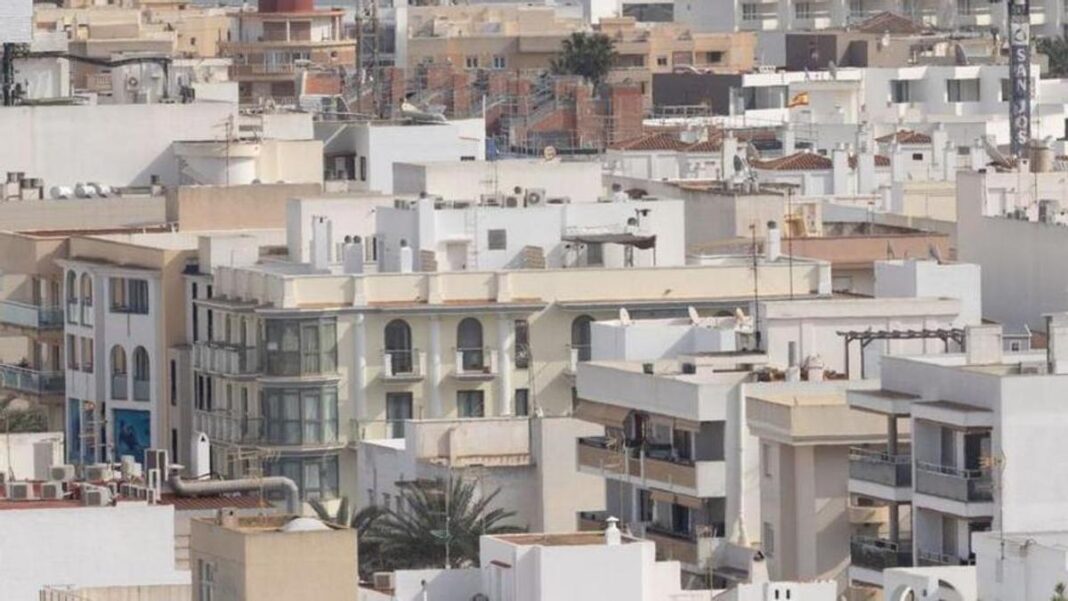
Ibiza’s real estate market remains under significant pressure and is once again among the most expensive in Spain, according to the Fotocasa Real Estate Index for November 2025. Several municipalities on the island are among those with the highest price per square metre in the country, with particularly strong year-on-year increases. Ibiza is consolidating its position as one of the most costly places in Spain to buy a home, with prices far above both the national average and those of most regions on the mainland.
Among the most expensive municipalities
The most expensive municipality on the island is currently Santa Eulària, with an average price of €8,666 per square metre (€/m²), a figure that places it at the top of the national ranking. It is closely followed by Ibiza town, at €7,553 €/m², confirming the capital as one of the least accessible markets in the country for both external buyers and local residents.
Other tourist municipalities also record very high prices:
- Sant Josep: €7,392 €/m²
- Sant Antoni: €7,054 €/m²
Regarding price trends, Sant Josep stands out with a year-on-year rise of 22.7%, one of the highest in the Balearic Islands. Other municipalities also show significant increases: Ibiza town, with a 13.7% year-on-year rise; Santa Eulària, with an increase of 2.2%; and Sant Antoni, which has no year-on-year data in the Fotocasa document but still exceeds €7,000 €/m².
These figures reflect “a sustained year-on-year increase driven by strong residential demand and intensive tourist use of the real estate market”, the portal notes.
A “critical” situation
According to Fotocasa, the surge in prices in the Balearic Islands —and particularly in Ibiza— stems from a “structural imbalance between supply and demand”. Demand continues to far exceed available supply, worsening the island’s housing-access crisis. Fotocasa spokesperson María Matos warns that the situation is critical: “Supply is unable to absorb the strong pace of household creation, while demand quadruples supply. In destinations like the Balearic Islands, the pressure is especially intense”.
The trend suggests that prices will continue to be under strain, especially in the most tourist-oriented municipalities, where residential and tourist demand converge in a market with very limited availability.