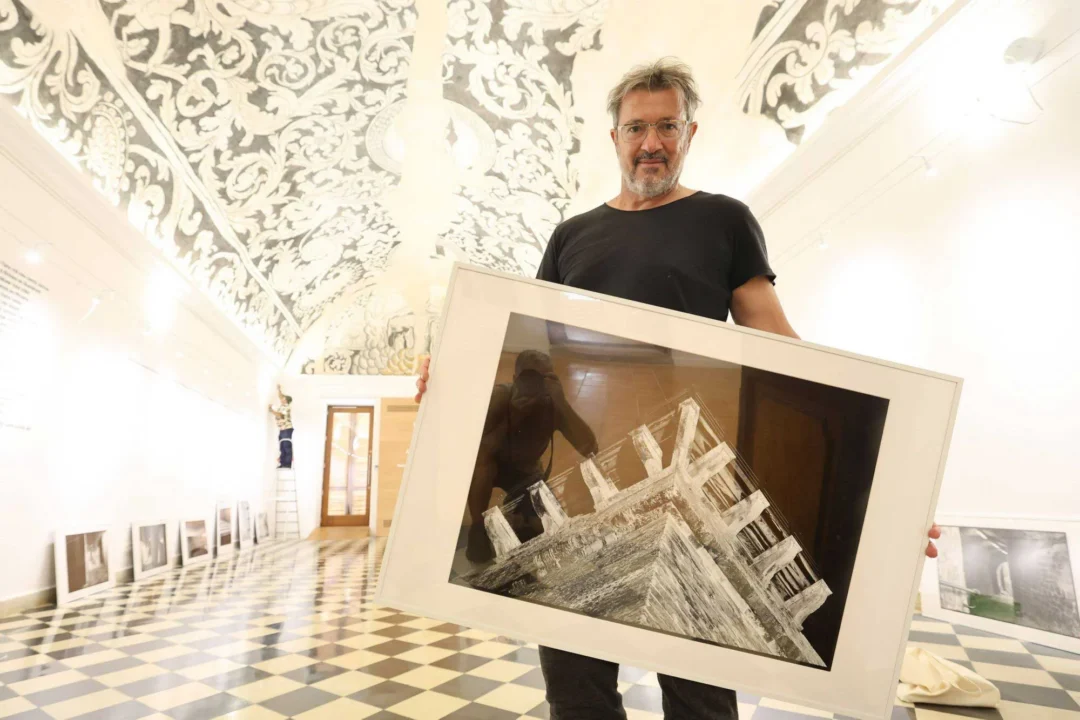
Costa opens Mirades perdudes (Lost Gazes) this Tuesday, a double exhibition at the Polvorí and the Refectori featuring 40 photographs. The exhibition is also a statement of intent: a return to black-and-white photography, a defence of the physical experience of photography over the digital world, and an invitation to stop and observe a historic old town that, in his view, has become “a backdrop for tourists”.
“A lost gaze is a gaze into emptiness. But is it possible to look into emptiness? In my view, the only way to do so is to stop looking — that is, to close your eyes or, in other words, to die. To live is to look, although it is possible to look without seeing.”
This is how Joan Costa, the Ibiza-born photographer, begins the text accompanying Mirades perdudes, the double exhibition he opens this Tuesday at the Polvorí at 8 p.m. and the Refectori of the Old Town Hall at 8.30 p.m.
“We never stop looking, but very often we stop seeing. Those are probably the true lost gazes,” Costa continues.
He has taken thousands of photographs of Dalt Vila, Ibiza’s historic walled city. He knows its stones, its streets and its hidden corners. He has witnessed and documented its changes. And he has also felt his own way of seeing the place evolve.
40 photographs and many ways of looking
After decades of observing Dalt Vila with his own eyes and through the viewfinder of his camera, Costa still wanders through the old town to discover what happens when you look again at something you have already seen countless times.
Sometimes he does not even set out intending to take photographs. He simply walks. He observes. He lets himself be carried along. A scene may emerge, or a particular light or shape may catch his attention. Or perhaps nothing appears at all.
That is precisely how he describes the origins of the exhibition: “Countless walks through Dalt Vila” over many years, many of them “without any real intention of taking photographs”, simply to enjoy the landscape and “the history contained in thousand-year-old stones.”
The idea was simply to allow his gaze to wander “here and there, without a specific destination, without a particular purpose”, until something demanded his attention.
Mirades perdudes brings together 40 photographs, 20 in each venue, selected after Costa went back through an archive containing more than 80,000 images, thousands of which feature Dalt Vila.
Some photographs are recent; others date back decades.
Costa acknowledges that the selection of those 40 images is tied to a particular moment. Had he chosen them a day earlier or a day later, he says, he would probably have selected different photographs.
“The personal moment. The state of mind,” he explains.
The exhibition brings together four different ways of looking. All belong to Costa, but each is distinct.
Some photographs were taken through the eyes of a photojournalist, others through those of a street photographer, while others are more poetic or more creative.
“I originally come from journalism, and the journalistic gaze is one thing. You go and look at something that is happening,” he explains.
The other three approaches, he admits, have made him feel considerably freer.
He sums it up more simply in the text accompanying the exhibition: “There are many ways of looking and, therefore, many ways of seeing things.”
We can observe how a scene unfolds, or we can focus solely on the setting, Costa points out. But he is clear about what he considers the best way to look:
“When we learn to see things that are not actually there.”
Dalt Vila as both setting and protagonist
The double exhibition plays precisely with this idea of setting and scene.
One of the exhibitions focuses more closely on the stones, history and architecture — the setting itself. The other moves towards what happens within that setting: the people and situations that pass through the historic heart of Ibiza.
“Dalt Vila is the protagonist,” Costa insists.
The photographer, who contributes to the Sunday supplement of Diario de Ibiza, says he rejected some photographs he liked because he could not recognise where they had been taken.
His intention was for people who know the area to be able to identify it, even when a photograph focuses on a detail or a particular scene.
The fact that the photographs are being exhibited precisely where they were taken is no coincidence. Costa wants the image and the place where it is viewed to remain connected.
He would like people who regularly walk through Dalt Vila to visit the exhibition and then, once outside and wandering through the walled city again, “see different things, or look at everything differently.”
He even suggests turning the experience into a small game: finding the places where the photographs were taken.
The idea of play is far from incidental. It comes directly from his own experience:
“Photography has always been something playful for me. Having fun, enjoying yourself, being entertained, playing.”
Dalt Vila: from an empty theatre to a tourist backdrop
There is an intimate relationship behind Costa’s fascination with Dalt Vila.
It is one of the places he escapes to for pleasure, even without his camera.
For a long time, what saddened him was finding it empty.
“Dalt Vila was a deserted place, like an empty theatre,” he recalls.
Now he feels almost the opposite:
“What saddens me is that it is full of tourists.”
He misses another kind of life in its cobbled streets.
“There are no local people, no Ibicencos,” he stresses.
In his view, residents have stopped inhabiting Dalt Vila. It is not simply that they no longer live within the walls; the area has also disappeared from their everyday lives.
They return only on specific occasions: the Medieval Fair, the Festes de la Terra and little else.
Costa uses an especially stark image to describe the situation:
“Right now, it is a theatre that is a backdrop for tourists.”
Against the screen
Mirades perdudes is not only about Dalt Vila. It also represents a change in Costa’s career.
Until now, many of his exhibitions had emerged from proposals made by others. This time, he was the one who wanted to find the space and present his own work.
And he intends to do so more often.
“I have always gone against the current, and I think now is the time to go against it more than ever,” he says.
That also means defending the physical experience of photography against the digital world.
Exhibitions. Books. Publications. Photographs that people have to go and see.
He does not even intend to upload the photographs from the exhibition to the internet.
“If people want to see the photographs, they should come. And if they don’t, they won’t see them,” he says firmly.
That also applies to the digital edition of this newspaper. Anyone wanting to see some of the photographs from the exhibition will have to turn to the print edition.
Joan Costa, who left social media some time ago, believes the sheer volume of digital images has ultimately diminished their value.
“It is a forest where everyone will get lost,” he says.
His intention for this stage of his career is clear: to devote whatever time remains to him professionally “to the physical rather than the digital.”
That desire to go against the current also explains another decision: returning to black-and-white photography.
It is a return to his beginnings and, at the same time, a reaction against an era he sees as saturated with colour images.
For Costa, a World Press Photo winner, colour has too often become the main attraction when it should simply be another element of the photograph.
Black and white, by contrast, forces both photographer and viewer to pay attention in a different way to composition and content.
“Colour is often a way of saving a mediocre image,” he says.
That does not mean he is abandoning colour altogether. But he wants a significant part of his work to return to a form of photography that forces him — and the viewer — to look differently at a time when more photographs are being taken than ever before.
That does not necessarily mean we observe more.
“We have eyes to look, but very often we don’t see.”
Costa distinguishes between taking photographs and being a photographer in much the same way as he distinguishes between writing and being a writer.
The fact that anyone can now produce images seems to him a natural consequence of technological progress.
The difference lies in intention:
“To be a photographer, apart from taking photographs, you have to look for meaning. You have to take photographs with meaning.”
That idea also appears in the text he has written for the exhibition, in which he describes feeling, as a photographer, “the duty to look” and “the responsibility” to capture some of those lost gazes.
“AI will make images, but it will not make photography”
In any reflection on the present day, it is inevitable that artificial intelligence enters the conversation.
Costa draws a very clear line:
“AI will be able to make images, but it will not make photography.”
He does not frame this as a moral question, but almost as a question of language.
A photograph, he argues, is made with a camera, whereas an image generated by artificial intelligence is produced on a computer using the work of professional photographers as its raw material.
That is another reason why he does not want to put all his work online:
“I don’t want to be part of the problem.”
In this discussion about swimming backwards, against the current, it is inevitable to ask whether he has gone as far as returning to film photography.
The answer is no.
Going back to analogue photography is not an exercise in nostalgia.
Costa retains what interests him about analogue photography — the texture, the language and the memory of the darkroom — while appreciating the practical possibilities offered by digital technology.
Ibiza’s roots: “They are roots, but they are dead”
When the conversation moves from photography to Ibiza, its roots, culture and traditions, the tone becomes darker.
“I don’t think they are in danger because we have already lost them. They simply no longer exist,” he says without hesitation.
He follows this with an even harsher metaphor:
“What remains are roots, but they are roots that are dead. They are no longer growing. They are still there, but like a fossil.”
Costa recalls a project he began in the early 2000s to document aspects of Ibiza that were disappearing.
Two decades later, when he wanted to revive the project, he discovered that much of that world had already vanished.
“We are already too late. There is very little left to document that hasn’t disappeared.”
He thinks of craftspeople, mestres d’aixa — traditional boatbuilders — and traditional ways of producing olive oil, wine and cheese that have ceased to be part of everyday life.
The city remains; the gaze changes
In 2012, Costa published a book about Dalt Vila.
The differences between those photographs and his current work have less to do with physical changes to the historic site than with changes in the photographer’s gaze.
At the time, the photojournalist’s perspective still dominated.
Today, his approach is more poetic, creative and emotional.
For much of his career, Costa worked on commission, with someone effectively telling him where to look.
Now there is no such instruction.
“I feel freer to look more or less however I want and in whatever way I want,” he says.
He goes out into the streets without a specific objective.
“Let’s see what comes out today, let’s see what I find, let’s see what I see,” he explains.
Many of the photographs in Mirades perdudes are the result of those aimless walks.
They reveal a “struggle between the old and the modern”, a deliberate contrast that Costa uses as a form of criticism.
And, once again, he returns to the idea at the heart of the exhibition:
“The best way to look is when we learn to see things that are not actually there.”