The Balearic government unveils a second refuge at Can Marines and reminds the public that capturing and confining Ibiza wall lizards requires official permission, following proceedings against a private individual.
“We’re hearing about things,” said Joan Simonet, the Balearic government’s Minister for the Natural Environment, back in June, when he unveiled the first safe refuge for Ibiza’s native wall lizard at the Can Marines Integrated Vocational Training Centre. The facility was designed as a kind of bunker to protect the island’s lizards from snakes.
At the time, Simonet warned that any such facilities required authorisation and supervision from the regional government, stressing that “the breeding of protected species, such as Podarcis pityusensis, must always take place under the supervision of scientists and the competent public authorities”.
His remark that “we’re hearing about things” was a reference to the fact that the authorities already knew of someone who, hoping to save the endemic species independently, had built a refuge of their own.
However, rather than necessarily helping the lizards, isolated captive populations could create problems linked to inbreeding and habitat fragmentation, effectively cutting off the flow of genetic material between populations.
“This has to be planned by the administration,” Simonet insisted. “We understand that people want to help, but…”
This Friday, Tomeu Moragues, head of the Balearic government’s Species Protection Service, and Irene Garneria, a biologist and senior technical officer within the same department, presented a second refuge at Can Marines. They also announced plans to establish a network of eight lizard refuges across Ibiza, potentially more. In June, the initial target had been four.
The announcement came a day after it emerged that the regional Department of the Natural Environment had opened disciplinary proceedings against a private individual over the “possession and confinement of specimens in a private refuge”. The alleged actions could constitute a serious breach of biodiversity protection legislation and carry a fine of up to €6,000.
The officials also used the opportunity to issue a pointed warning, without naming those involved, to the individual facing proceedings and her adviser, biologist Maria Antònia Cirer, who had held a press conference of their own that same morning.
“Someone has done something they are not allowed to do simply because they wanted to and believed they were doing something good. But Law 42/2007 on Natural Heritage and Biodiversity prohibits this, because it is a protected species that cannot be relocated or moved from where it is found. Nor can it be confined without prior authorisation,” Garneria explained.
Official authorisation is essential
Garneria stressed that the individual had not obtained the necessary permit.
“If a scientist wants to study a protected species, they must first apply for authorisation. The application is assessed from both a scientific and technical perspective, after which a decision is made on whether permission should be granted and, if so, under what conditions,” she said.
According to Garneria, no such application had been submitted.
“We are not assessing whether the project has been carried out properly. What has been assessed in this case is that there was no authorisation. No prior authorisation had even been requested.”
The disciplinary proceedings were launched on 26 April, following an inspection by environmental officers from the Balearic government.
Other organisations have applied for permission and could receive the necessary authorisation shortly, Garneria added.
“We are drafting an agreement with a private organisation that has offered us a site for this work, which will become part of the entire network of government refuges.”
Her message to the public was clear: “People need to understand that the lizard is a protected species, that handling it is a very delicate matter and that authorisation must be requested. It is perfectly logical.”
First Can Marines refuge has been occupied since October
The first refuge at Can Marines is already home to a population of 40 lizards captured in south-west Ibiza. They arrived in October, four months after the facility was officially unveiled.
“It is because in June we did not yet have all the necessary permits. We needed a zoological establishment licence. There is a process that we have to follow entirely legally, meeting all the requirements,” Garneria explained.
Most of the residents are female: 24 of the 44 lizards currently accounted for are females and 16 are males. The sex of the remaining four has not yet been determined.
Garneria explained that this was related to territorial behaviour.
The refuges will operate “in a coordinated way”, with each facility potentially serving different purposes, including species conservation, environmental education and scientific research.
One possible area of research is how individual lizards react to snakes, including whether they attempt to flee or remain frozen in place when confronted by a predator.
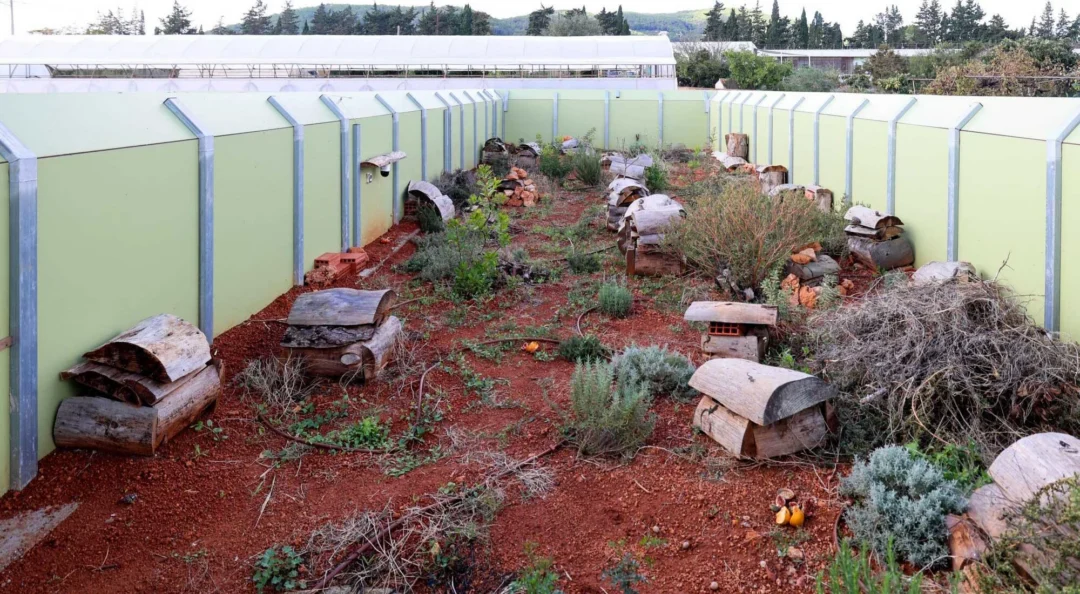
The first refuge has been designed to recreate a suitable natural environment. It includes native vegetation, rock formations, natural shelters made from logs, access to water through a small pond and habitats that encourage the presence of invertebrates, which provide the lizards’ main food source.
The second refuge at Can Marines has not yet been officially opened and still needs to be prepared.
“The structure is there, but it does not yet have the vegetation or the shelter areas. However, it will be ready very soon,” Garneria said.
The goal: restore areas devastated by invasive snakes
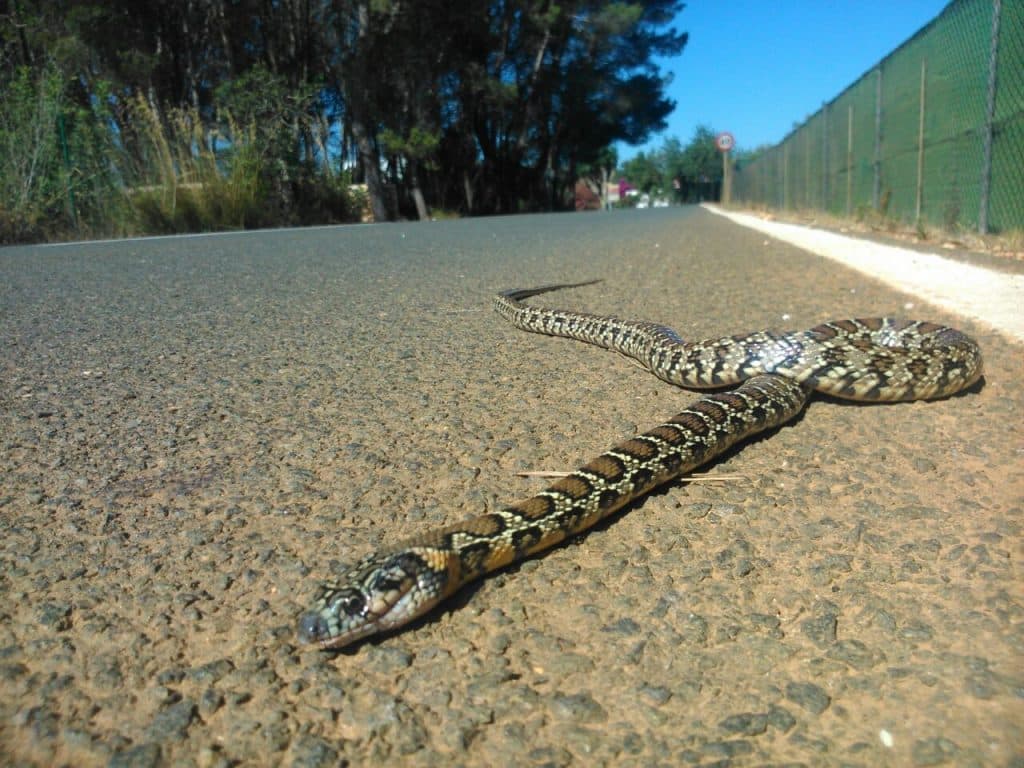
The long-term aim is for these refuges to become small reservoirs of life, providing healthy lizard populations that could eventually be used to repopulate areas devastated by horseshoe whip snakes and ladder snakes.
For reintroductions to succeed, however, suitable conditions must first be in place, meaning areas with a low or virtually non-existent snake population.
Some parts of Ibiza, particularly in the north and centre of the island, have already seen a significant decline in snake numbers. These are the areas where the invasion first began, and they could provide the first opportunities for reintroducing the native lizard.
“There are places where the situation is no longer what it was when the invasion began many years ago. We can try reintroductions there,” Garneria said.
The conservation programme will also draw on lizards kept at Barcelona Zoo, where another 30 specimens from six islets were transferred this year, according to Tomeu Moragues.
Madrid Zoo Aquarium has also expressed interest in housing populations of Ibiza wall lizards. Meanwhile, Bioparc Valencia already has a group originating from the Catalan zoo.
Moragues emphasised the need to expand this network of institutions in order to strengthen the species’ breeding programme and improve the chances of successful conservation.
The ultimate goal is to help secure the future of Ibiza’s endemic wall lizard, a distinctive part of the island’s natural heritage that has come under growing pressure from invasive predators.