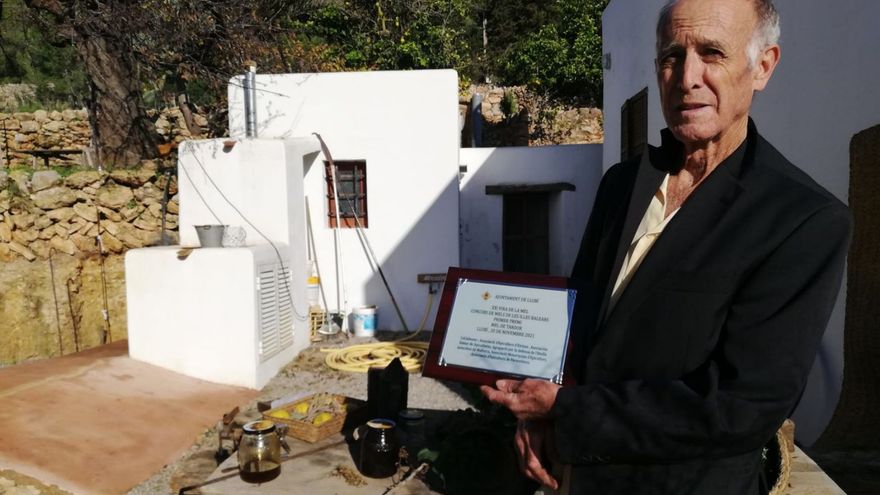
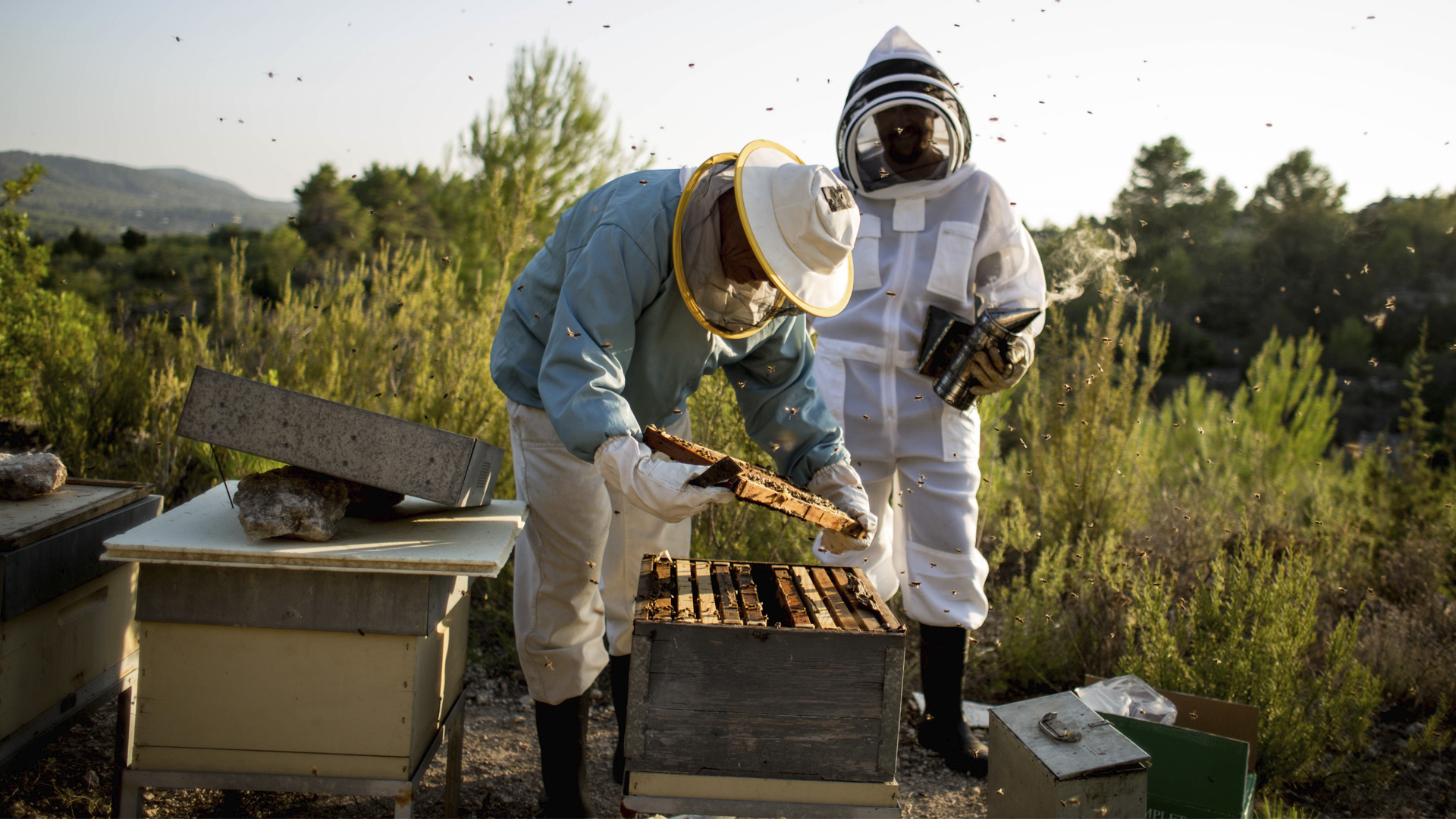
Ibiza’s beekeepers are taking part in Sunday’s Fira d’Estocs in Vila to promote local honey and raise awareness of the challenges facing the island’s native honeybee.
Ibiza’s beekeepers and other agricultural professionals are facing a “very serious problem” due to drought, according to Vicent Marí, president of the Ibiza Beekeepers Association and head of the Regulatory Council for the Mel d’Eivissa Protected Designation of Origin (PDO).
Marí is attending Sunday’s Fira d’Estocs in Vila at the association’s stand, where beekeepers are selling locally produced honey and raising awareness among visitors about the importance of bees.
“This is a drought on a scale we haven’t seen for 75 years. We have lost practically between 40% and 50% of our hives. No matter how much we try to replicate natural feeding with local alternatives, we can never reproduce what nature itself provides,” he explains.
The island’s countryside failed to produce the flowering that bees would normally rely on. “There has been no rain since May and the flowering disappeared completely, which is why many bees died,” Marí says.
“It’s not just about keeping the hives alive; it’s a matter of survival,” he adds.
Rain has returned recently, but Marí says it has been particularly intense. “It has rained now, but very heavily. If it continues raining through the winter, we may be able to recover a little. If not, things will be quite difficult,” he says.
The association’s president warns that the effects could continue into next year. “Given the drought we have been experiencing, if it carries on into next year, we will continue losing bees.”
To keep their colonies alive, beekeepers have had to feed them more frequently. “We used to feed them every month and a half or every two months. Now we have to feed them every 15 days,” Marí explains.
Stolen hives: the search for those responsible continues
In April this year, 11 hives and 13 nuclei of native bees were stolen from Portinatx. Marí recalls the incident as a devastating blow to efforts to preserve Ibiza’s own bee population.
“It was a project we had been developing since 2018, and only two or three [colonies] survived. Whoever did it must have known exactly what they were dealing with. It was carried out by professionals,” the association’s president says.
“Eight years of work have been lost, along with a great deal of money and enthusiasm invested in the project. We are trying to move forward with what little we have left,” he adds.
The association has received no updates on the case, either from the court handling the investigation or from the National Police, with whom the theft was reported.
Beekeepers call on public authorities for support
The association is now asking the authorities for financial assistance to help offset the money invested in protecting Ibiza’s native bees.
“What we are asking institutions to do is help us, at least by covering part of what we have invested,” Marí says.
He says the association has requested assistance from the Balearic Islands government, but has yet to receive a response. The Ibiza Island Council, he adds, may appoint a technical team to assess whether the bees need additional feeding.
“I believe the need is clear,” he says.
How residents and visitors can help Ibiza’s bees
Marí believes that both residents and visitors can play a role in supporting local beekeeping and protecting the island’s bee population.
“To help, the first thing people can do is buy local products. Secondly, they should plant as many nectar-rich plants that attract bees as possible,” he says.
Among the plants he recommends are rapeseed, lavender, thyme and rosemary, all of which can provide valuable resources for bees.
Supporting local honey producers and planting bee-friendly vegetation are practical ways to help sustain Ibiza’s beekeeping tradition and the native bees that are an important part of the island’s natural environment.