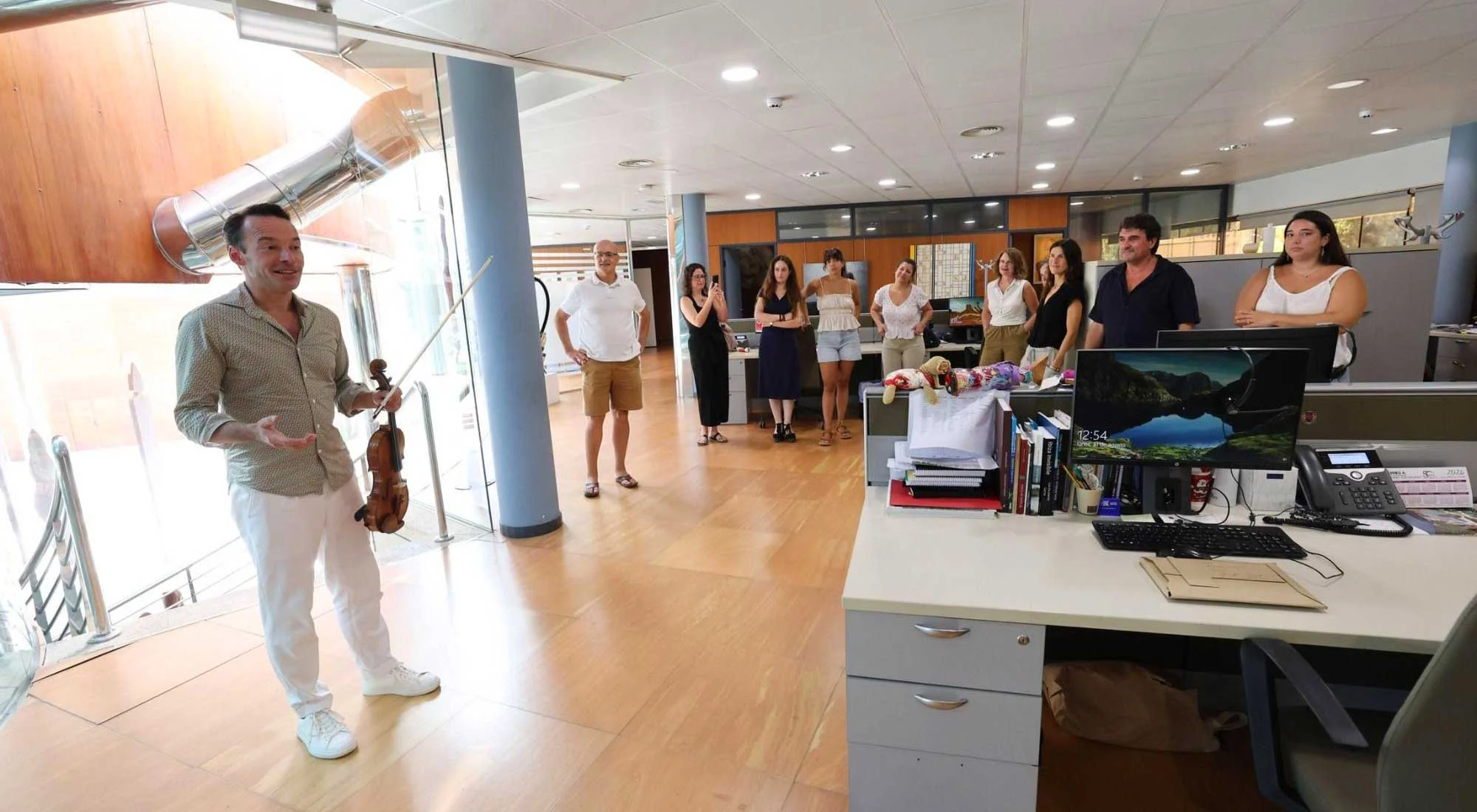
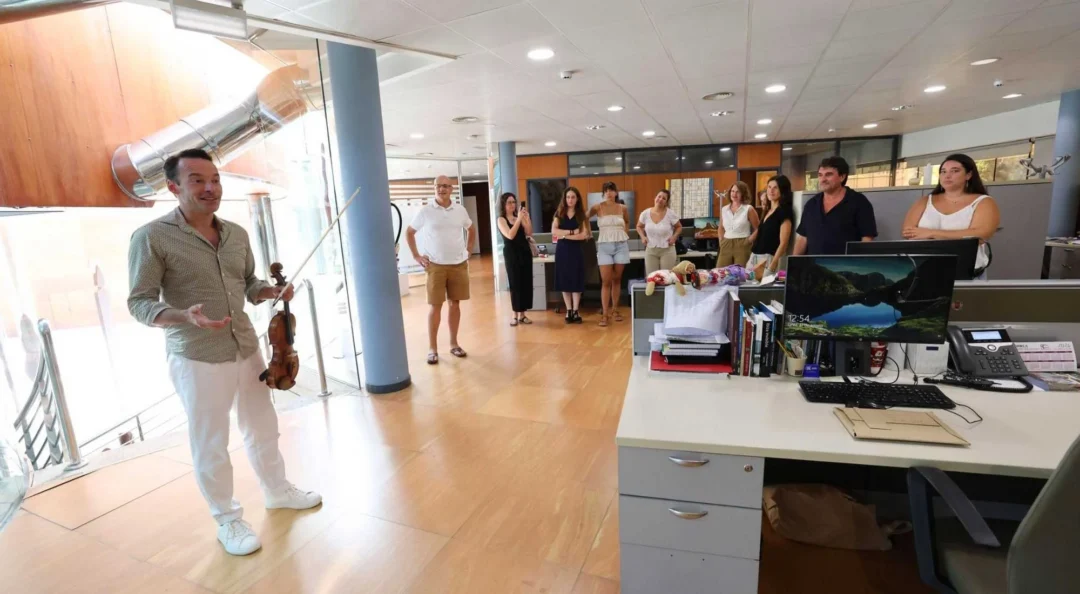
The newsroom of Diario de Ibiza was transformed into an impromptu concert hall on Monday lunchtime when renowned German violinist Linus Roth stopped by for a very special performance. “A little Vivaldi, a little Paganini,” he explained as he played excerpts on his 1703 Stradivarius violin, a priceless instrument and one of the highlights of his visit.
Roth performed as a gesture of appreciation for the work carried out by Diario de Ibiza, which has been promoting and covering the island’s cultural life for more than 133 years.
During his visit to the newspaper’s headquarters, the violinist also invited staff and the wider public to attend Monday evening’s concert at 9 p.m. in the Cloister of Ibiza Town Hall. The performance forms part of the eighth edition of the Ibiza Concerts International Festival, where Roth will perform alongside musicians from Brazil’s Johann Sebastian Rio Orchestra.
The concert brings together European classical music and Brazilian rhythms in a programme titled “Sambach”, a playful combination of Bach and samba. “It’s a spectacular programme because it is a fusion of classical music and Brazilian music. We start with Bach and then take the audience on a musical journey from Europe to Brazil, with Bach and samba,” Roth explains.
“Diario helps the festival enormously”
Asked about his decision to perform for the newspaper’s journalists, advertising team and administrative staff, Roth highlighted the importance of the media in helping cultural events reach their audiences.
“Diario helps the festival enormously,” he said, referring to the Ibiza Concerts International Classical Music Festival. “Without an audience, there is no concert and there is no culture. Culture only exists with people and for people. But if nobody knows that something is happening…”
During the performance, Roth also played music by Vivaldi, The Girl from Ipanema and Paganini, one of his favourite composers to perform.
“I really enjoy playing this piece and it sounds very different,” he said. Some members of the audience may have heard the pizzicato technique for the first time: instead of using the bow, the violin strings are plucked with the fingers, producing a sound closer to that of a guitar.
“It is a very special and difficult technique. Not everyone can do it,” Roth explained. Paganini, he added with a smile, is particularly demanding. “Paganini is the most difficult, which is why we say it is the music of the orchestra from hell. It sounds almost demonic.”
How Linus Roth fell in love with Ibiza
Roth has played the violin since he was six years old and studied with some of the most respected teachers in the field, including Professor Zakhar Bron and Professor Ana Chumachenco.
His connection with Ibiza began around 15 years ago, when he first travelled to the island after being encouraged to visit by Margarita Kinsberger, a German woman who lived in Ibiza and played an important role in promoting classical music and opera on the island.
“She told me I had to come to Ibiza, and I thought: ‘Classical music in Ibiza?’ But she organised concerts regularly, and they were charity events supporting Ibiza and Formentera Against Cancer. That is how I first came to Ibiza,” Roth recalls.
Four years later, Kinsberger told him she was too old to continue organising the concerts. By then, however, Roth had already fallen in love with the island.
“Ibiza is my home and my favourite place in the world,” he says.
His connection with the island eventually led him to establish the Ibiza Concerts International Festival in 2018. “There wasn’t an international festival here with the reputation and level of classical music that I wanted to see, so for the past eight years I have been bringing some of the best musicians in the world to the island,” he says.
With a touch of humour, Roth also admits that the festival provides him with a good “excuse” to keep returning to Ibiza.
“Something different from mass tourism”
Roth believes Ibiza has the potential to develop a much stronger identity as an international cultural destination, alongside its world-famous nightlife and tourism industry.
“I’m pleased to hear that the Consell sometimes wants to promote alternatives to mass tourism, particularly cultural initiatives. In that sense, I am always available,” he says.
His long-term ambition is clear: “I would like to turn Ibiza into an international cultural destination, and that is the ultimate goal of the festival.”
For Roth, this does not mean replacing Ibiza’s famous nightlife. Instead, he believes the island needs greater balance.
“The parties are good, the clubs are great… everything is fine. But we need more. We need a balance,” he argues.
When he tells people in Germany, France or Brazil that he organises an international classical music festival in Ibiza, their reaction is often one of surprise.
“I see it as an opportunity for any kind of music that is not electronic,” he says.
He also praises the local audience, describing Ibiza’s concertgoers as “great”.
“They are very enthusiastic, and it is great fun to perform here.”
Ibiza as a laboratory for musical experimentation
Roth sees the island as the perfect creative laboratory for musical experimentation, where classical music can be combined with other artistic traditions and genres.
“We did a project a few years ago combining classical music and flamenco. Two dancers performed, one from Mallorca and Rocío Osuna, a fantastic dancer from Ibiza. I played something similar to flamenco on the viola while they danced.”
For Roth, Ibiza is his experimental studio.
“I try many new programmes on the island. If they work, I take them and export them to other international festivals,” he explains.
Nevertheless, the violinist believes musical fusion needs to be approached with care. “Not everything works, just like in cooking,” he says.
Despite his interest in experimentation and cross-genre collaborations, Roth ultimately remains firmly rooted in classical music, using Ibiza as a platform to explore new ideas while showcasing the genre to audiences both on the island and internationally.