
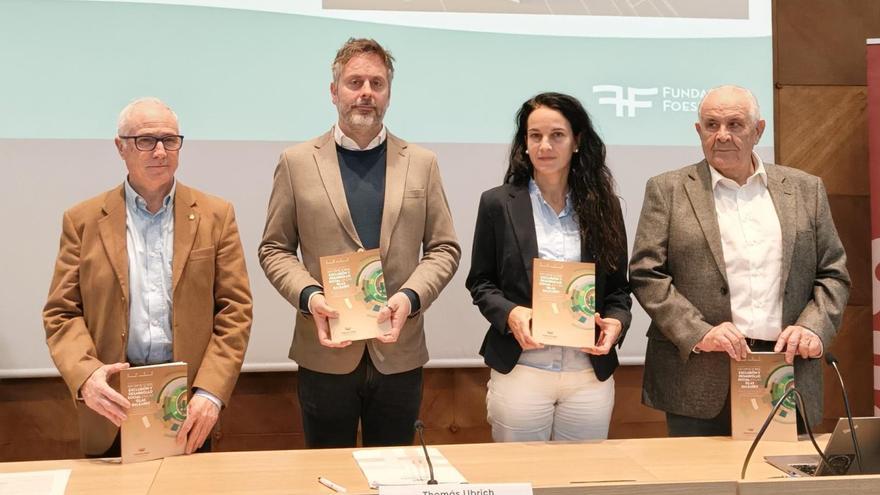
For some time now, having a job has ceased to be a guarantee of anything in the Balearic Islands. The IX Foessa Report on Social Exclusion and Development, presented on Wednesday by Cáritas Diocesana of the Balearic Islands and the Foessa Foundation in Palma, warns that employment no longer acts as a real shield against poverty. According to the study, social exclusion among employed people has grown significantly over the last six years, rising from one in ten to almost one in seven.
The study identifies housing as the main driver of inequality in the Balearic Islands and the real “bottleneck” of social integration. According to the data, 29% of the population suffers residential exclusion in a context marked by a sustained rise in the real estate market: housing prices have increased by 41% since 2018, while the average rent now reaches 1,598 euros per month, 31% more than in 2019. In addition, more than 60% of tenants spend over 30% of their income on housing.
The consequences are profound: 46,000 households fall below severe poverty levels after paying rent and utilities.
Stressed areas in Ibiza
The study estimates that 110,000 people in the archipelago live in unsafe homes and a further 100,000 live in inadequate or overcrowded housing — a situation that is particularly serious in the most stressed areas of Ibiza. It also highlights the high rental prices on the island, where access to housing “is increasingly difficult”, leading to “a rise in situations of residential exclusion”. In fact, among municipalities with more than 20,000 inhabitants, the three most expensive rental markets in the Balearic Islands are in Ibiza: Ibiza town, Sant Josep and Santa Eulària.
Overall, the report notes that 19% of the population of the Balearic Islands — more than 233,000 people — live in a situation of social exclusion, a figure that has remained practically unchanged since 2018. Although severe exclusion has fallen by 13%, 94,000 people remain trapped in extreme situations.
Thomas Ubrich, sociologist and member of the Cáritas and Foessa research team, stresses that it is not individuals who fail, but the social protection system: “Economic growth has not been accompanied by social integration. The myth that people live off aid and benefits is false. Most households work, actively seek employment, study and train, but come up against structural problems”.
“Housing pushes people out of the territory and out of a dignified life”, Ubrich warns, insisting that “it is not the people who fail, but the system”. According to the sociologist, most households in active exclusion undertake strategies to overcome their situation, but face structural barriers and fragmented support mechanisms.
Although the Balearic Islands have created employment — rising from 560,000 to 607,000 employed people since 2018 — the report finds that this growth has not improved social integration. Wages have increased by 20% in nominal terms, but only 3.3% in real terms due to the rise in the cost of living.
More employment and more exclusion
The Balearic Islands create employment but do not reduce social exclusion. Job insecurity, involuntary part-time work and insufficient wages prevent employment from serving as a pathway out of vulnerability.
Cáritas calls for ambitious policies to expand the public housing stock and curb “abusive” price increases, warning that housing has become a “fake right”.
The Foessa Report, as Ubrich explains, also identifies a serious deficit in the income guarantee system. The Minimum Vital Income (IMV), he notes, reaches only 35% of people in severe poverty in the Balearic Islands, while 66% of households in this situation have never received information about the benefit.
The Guaranteed Social Income (Resoga), meanwhile, has suffered a “drastic setback”, dropping from covering 1% of the population in 2018 to only 0.44% in 2024. This combination, he adds, creates an “informational and administrative vacuum” that leaves thousands of households in fragile situations without protection.
The report also identifies gaps that worsen inequality. Foreign nationals face exclusion rates of 31%, more than double those of the Spanish population. Minors and young adults are also among the most vulnerable groups, with 24% of people under 18 and 26% of those aged 18 to 44 living in social exclusion.
Households with minors account for two thirds of the population in exclusion in the Balearic Islands. Moreover, discrimination affects one in five households, and almost one in two among those living in exclusion; 88% report having lost work or social opportunities as a result.
A specific study on Ibiza due to its serious situation
The 9th Foessa Report on Social Exclusion and Development in the Balearic Islands is based on a survey of 834 households in Mallorca, Menorca, Ibiza and Formentera (a total sample of 2,021 people) and is part of research carried out by 140 specialists from 51 universities and third-sector organisations. In Ibiza, 285 surveys were conducted and 551 in the rest of the Balearic Islands. In addition to the general report, Foessa has prepared a specific territorial study on exclusion and social development in Ibiza, which will be presented in mid-January.
Sociologist Thomas Ubrich, a member of the Cáritas and Foessa research team, warns that the current social model “is exhausted” because “it produces inequality, precariousness, isolation and growing social mistrust”. He calls for a new social pact based on care, social justice and ecological sustainability, and proposes policies that address the root causes of inequality, with special attention to housing.