
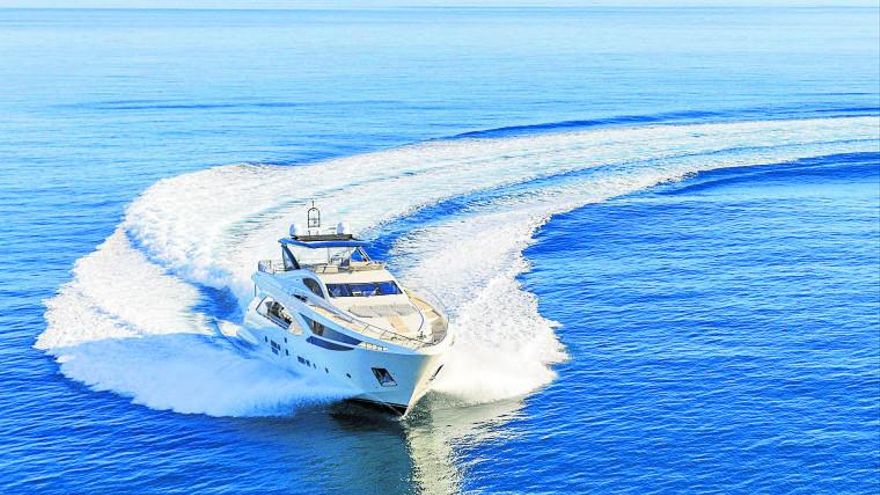
Boat shows have always been the forum where there is an interaction between the industry and boaters, where brands present their innovations and fans solve their big questions. The Salón Náutico de Barcelona (Barcelona International Boat Show), which took place from 12 to 17 October at the Port Vell, wanted to answer some of these questions and reveal the latest developments and trends of recreational boating with sustainability as its main challenge and goal. Here are the five big questions.
Will hydrofoils prevail in boating?
There is still a long way to go, especially in sailing, but we can already say that hydrofoils or foils are not only fashionable, but are the main technological revolution that can change the way we understand sailing.
The principle of their physical function is practically the same as that of the wing of an airplane: lift through pressure difference, but, in this case, they are submerged. Its use results in less drag, less fuel consumption and better sailing performance, since lifting the hull on the waves allows to faster sailing, without pitching or rolling.
Among the technical difficulties to be improved is that, as the wing has to be submerged, it forces the use of longer vertical transmission shafts, so that at low speed or when stationary, the draft is much greater than a conventional transmission. Of course, foils can be liftable, but this complicates their mechanics, strength and price.
However, taking into account that the manufacturing technology is still in its infancy, they will soon be common place, especially on small, lightweight displacement powerboats. In sailboats, their use does not allow the hull to be fully raised, but improves lift, reduces wetted surface and, therefore, increases speed. However, its implementation in ocean racing yachts has shown its fragility against the big waves of the South Seas.
Will wood make a comeback?
It is not out of the question. After more than half a century of building in stratified fibreglass and resins, we are still far from being able to recycle the old boats, so their advantages in terms of mass production and price contrast with a very poor environmental balance.
Advantages of wood? Resistant, adaptable, modellable, allows all kinds of finishes and, above all, an origin in a renewable and non-fossil source: forests. It is true that it is a more absorbent material and more sensitive to rot, however, the advances in coatings is far from how boats were built before the proliferation of plastic.
It is not a question, then, of returning to the depletion of forests of slow-growing species, but of using fast-growing species (bamboo, sandwich, red cedar, flax fibres) combining their use with materials that increase their impermeability and resistance to bacteria and fungi.
The problem: the price we are willing to pay. But if we pay it for a Tesla, why not for a boat?
Will teak still be used on deck?
There is no doubt that teak offers the best qualities for lining boat decks with wood. But, like fossil fuels, it is not an unlimited resource. Moreover, if we add the costs of felling and, above all, transporting it, the energy balance of its use is disastrous.
Are there substitutes? Not natural ones. All the woods that can be used, even those used to line the old galleons, such as oak, are slow-growing, scarce species.
Today, however, we have synthetic teak, which is thinner, aesthetically similar to natural teak, very resistant, durable and light . Among its disadvantages, it absorbs a lot of heat, which is not a problem in the Nordic countries, but it is a problem in the Mediterranean. Cork can also be a substitute: light, impermeable and elastic, it is extracted every seven or ten years without damaging the cork oak.
Do antifoulings have a future in boating?
For environmental reasons, manufacturers of antifoulings must meet very strict requirements. As a result, the biocides permitted by European directives are very limited, while the effectiveness of conventional products tends to decrease, as is the case with household paints without solvents or metallic pigments.
An advantage in terms of protecting the marine environment paradoxically leads to a greater risk of spreading invasive species transported by dirty hulls, whether from commercial ships or pleasure craft that move from one sea to another and from one port to another throughout the year.
Aware of this, manufacturers are proposing new and effective alternatives to biocides, such as non-stick gel surfaces or ultrasonic waves, which instead of destroying the micro-organisms that adhere to the hull, prevent them from sticking thanks to non-stick molecules or silicones.
Is hydrogen really an alternative in boating?
It is an alternative, but for the time being, hydrogen-powered boats have not gone beyond the experimental phase. In fact, the answer to the question is to be found in the automobile industry, which is leading the way and is closely related to the dependence on lithium-ion batteries, a technology that presents many environmental problems due to its scarcity, production difficulties and waste treatment.
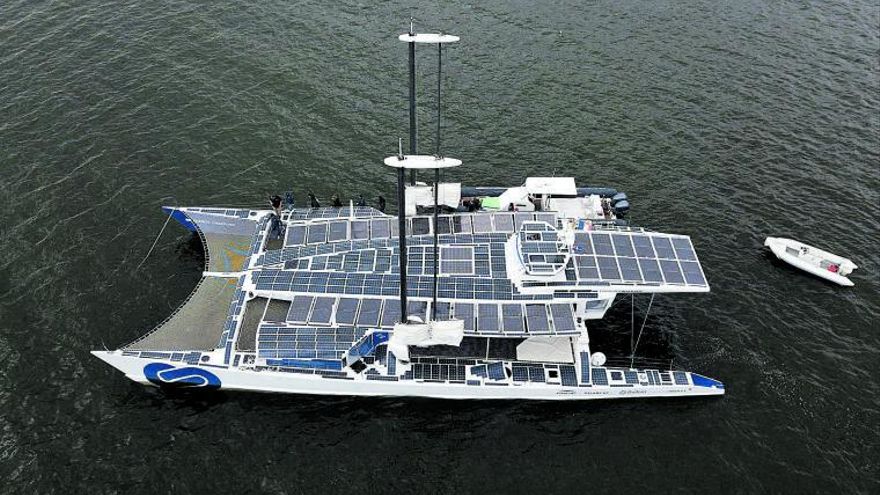
There are already vehicles, buses, trains or boats powered by fuel cells, which do not store energy, but produce it to be stored and with a price per kW similar to that of a traditional fuel. But to have a lot of autonomy hydrogen must be compressed in large tanks capable of withstanding high pressures in boating without risk.
Tests have been carried out, such as the round-the-world trip of the Energy Observer catamaran, with a fuel cell, or an experimental pleasure boat built in France equipped with a hydrogen tank, a fuel cell and electric motors, but its range has not exceeded 50 miles, a figure that is currently encouraging, but not sufficient.