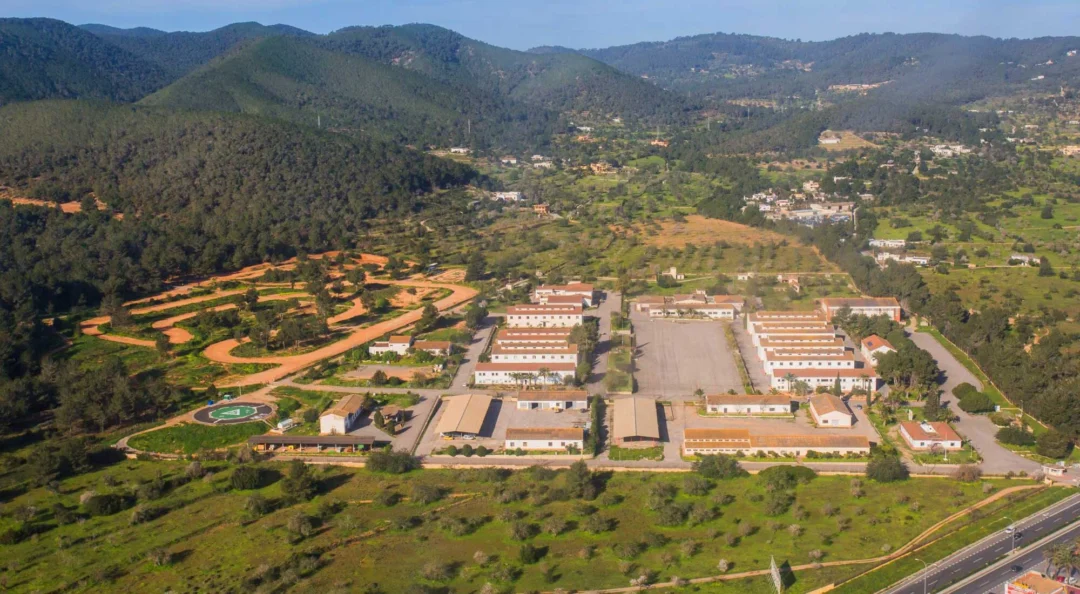
A section of the former military facilities at Sa Coma in Ibiza is set to be transformed into a Wildlife Rescue and Interpretation Centre, specialising in veterinary care for injured turtles and birds, as well as the treatment of exotic species.
The project is being promoted by the Balearic Government’s Department of the Environment through the public company Tragsa, which has now put the construction work out to tender with a budget of €437,000. The investment will be funded through the Sustainable Tourism Tax (ITS), and the works are expected to take six months to complete.
The initiative dates back to late 2019, when the Ibiza Island Council transferred a 22,280-square-metre plot to the Balearic Government. The site includes several existing structures that can be reused, such as a service building and a water cistern.
The land is located in the wooded area of Sa Coma, at the foot of the hill and outside the central section containing the former military barracks.
The new centre will include four wildlife rehabilitation enclosures, an aviary for birds and a dedicated area for turtles. These facilities will be protected by mesh fencing to prevent predators from entering. The plans also include seven cages for exotic animals that may be found across the Pityusic Islands, according to the project specifications.
The enclosures will be designed to make animal care, cleaning and maintenance easier. They will feature water points, drainage systems for waste and leachate, secure fencing and protective mesh to prevent animals escaping or predators gaining access.
The facilities for exotic species will consist of seven modular metal cages. Four will measure four metres long by two metres wide, while the remaining three will measure four metres by 1.5 metres. All will be two metres high and separated by opaque panels.
The future centre will also include a dedicated platform for cleaning and carrying out necropsies on larger animals, equipped with a high-pressure water system and a central drain. Additional infrastructure will include a 20-cubic-metre manure storage area and a septic tank to collect wastewater generated by the centre’s activities.
Cofib to be restructured as a fully public organisation
Until now, the project has been driven by the Consortium for the Recovery of Wildlife in the Balearic Islands (Cofib), a regional body that has operated in recent years under an agreement with the Natura Parc Foundation.
From 2027, however, Cofib is due to be restructured into an organisation under exclusively public ownership. At the end of September, the Balearic Government’s Minister for the Natural Environment, Joan Simonet, announced that Cofib’s professionals would be transferred to the new organisation, which will be called Biona (Balearic Islands Biodiversity and Nature Foundation).
The Sa Coma development will also have an educational and public outreach role. The project includes programmes for schools and designated observation areas where visitors will be able to see animals undergoing rehabilitation.
The project documentation also makes clear that some of the centre’s facilities will serve purposes beyond veterinary care. Sa Coma is also intended to strengthen efforts to control the spread of Pennisetum setaceum, a highly invasive grass species.
Native to Africa and the Middle East, the plant is also known as fountain grass or crimson fountaingrass. It was originally introduced as an ornamental feature in private gardens before spreading as far as Puig des Corb Marí, within the Ses Salines Natural Park.
Record numbers of rescued animals
The new veterinary centre at Sa Coma comes in response to the growing number of wildlife rescue operations recorded in recent years.
The latest annual report from Cofib highlights a record level of activity in 2025, when the organisation treated a total of 7,637 animals across the Balearic Islands. Of these, 547 were in Ibiza and around a dozen in Formentera.
In the Pityusic Islands, birds account for the largest share of rescued wildlife. These include small birds of prey such as the kestrel, insect-eating species such as the swift, and seabirds including the Balearic shearwater and Audouin’s gull.
Hedgehogs make up almost all the terrestrial mammals treated by Cofib, mainly following road accidents or falls. At sea, most rescue operations involve loggerhead sea turtles that have become entangled in plastic waste or fishing nets.
Cofib also carries out extensive work across Ibiza and Formentera to remove invasive snakes, particularly horseshoe whipsnakes and ladder snakes. These reptiles, however, are recorded separately from protected wildlife rescue figures.