
Tourism depends on the destinations it brings visitors to. That was the central message from Luigi Cabrini, president of the Global Sustainable Tourism Council (GSTC), during the second day of the HIC Summit in Ibiza, where international experts warned that the industry must do much more to address climate change, overtourism and the deterioration of natural ecosystems.
“If beaches disappear because of rising sea levels, if biodiversity is lost because temperatures are too high, if people stop coming to Ibiza in July and August because it is too hot and humid… Tourism is the sector that should really be most concerned about mitigating the effects of climate change. Are we doing anything about it? Yes. In my opinion, not enough.”
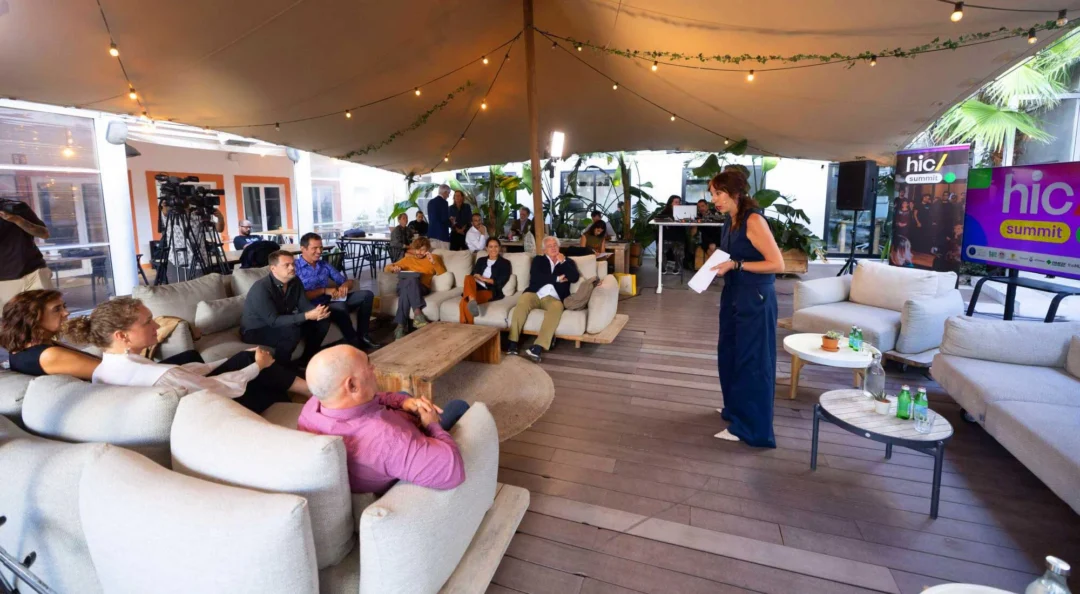
Cabrini made the remarks during a panel discussion at The Hub Ibiza on Thursday, as part of the annual HIC Summit, a conference dedicated to sustainable tourism and destination regeneration that brings together international figures from the world of corporate social responsibility.
The session, entitled Tourism, Oceans and Nature-Inspired Science, brought together specialists in tourism destinations, environmental researchers and oceanographers. Representatives from Palladium Hotel Group, the Seychelles and the United Arab Emirates also took part.
The first vice-president of Ibiza’s Island Council, Mariano Juan, and Santa Eulària mayor Carmen Ferrer did not attend the event due to the national mourning period following the railway tragedy in Urda.
Tourism destinations need to put sustainability first
Cabrini outlined the work of the GSTC, which has been assessing key indicators in tourism destinations since 2007 to provide guidance on environmental protection and sustainability.
As an example of successful destination management, he described the transformation of Roatán, an island in Honduras that he first visited 40 years ago, when it had no hotels.
“Twenty years later, it had 15 resorts. There were serious problems with tourism management and extremely heavy environmental pressure,” he recalled.
According to Cabrini, the advice provided by his team helped bring about a significant improvement in the island’s sustainability after five years of changes to the way tourism was managed.
However, he stressed that lasting transformation requires the involvement of the local community.
“Only when active representatives of the community are empowered — that is, when they are able to express their opinions — can they become genuinely committed. I think something imposed from outside or from above is unlikely to succeed,” he said.
Cabrini also emphasised that there is no single formula for sustainable tourism. Each destination has its own circumstances and must be assessed individually.

Overtourism and the challenge of managing visitor numbers
“Some of the problems we are all aware of right now are overtourism and poor management of tourist destinations,” Cabrini said.
He pointed to Spain’s growing visitor numbers, saying the country was expected to exceed 100 million international tourists for the first time in its history by the end of the year.
“After the pandemic, which brought a 70% drop in tourist numbers, last year we returned to the same number of tourists we had in 2019. The forecast is that numbers will continue to rise by between 2% and 3% a year,” he explained.
However, Cabrini argued that simply restricting visitor numbers is not necessarily the answer for every destination. Decisions should be based on local circumstances.
He cited the Croatian coastal city of Dubrovnik, with a population of around 40,000, where up to six large cruise ships carrying 5,000 passengers each were once arriving at the port.
“That was completely unmanageable,” he said. “Involving the local community, as I said earlier, is extremely important and, in some cases, why not? Setting limits.”
Ageing hotel infrastructure poses sustainability challenges
Gloria Juste, vice-president of Sustainability and Corporate Social Responsibility at Palladium Hotel Group, discussed the difficulties the company faces in meeting its sustainability targets, particularly when dealing with older hotel buildings.
“It is easier to take action when you are starting from scratch,” she acknowledged. “The problem is with older hotels. You cannot carry out renovations every month in every destination. A hotel that is more than 15 years old is a concern.”
Juste also discussed two new five-star hotel developments the group is building in Vietnam: Bless Hanoi, which is scheduled to open next year in the capital, and L’Alya Ninh Van Bay, a luxury resort made up of private villas in the unspoilt Nha Trang Bay, in the south-east of the country.
The group plans to use these developments as a starting point for further expansion across Southeast Asia. To support that strategy, it has established a new headquarters in Ho Chi Minh City to coordinate its regional growth.
“When you have a new building, it is wonderful. Consumption is reduced by half. It really does work,” Juste said.
Protecting the oceans through cooperation
The second part of the day’s programme focused on the marine environment and the need for scientists, businesses and public authorities to work together to protect ecosystems without abandoning economic activity.
José Manuel Lapeña, Seychelles’ consul general, presented the approach adopted by the 115-island archipelago, where the sea is a vital resource for two major local industries: tourism and fishing.
Protecting fish stocks, involving local communities and placing limits on urban development are among the measures used to safeguard the environment and manage tourism growth.
Lapeña summed up the Seychelles’ approach to controlling tourism with a phrase: “Better a hundred at a thousand than a thousand at a hundred.”
He explained that the authorities recognised from the early stages of tourism development that growth would need to be controlled if they were to avoid destroying the natural asset that had made the islands attractive in the first place — and which had once supported their fishing-based economy.
The Bay of Biscay and Cantabrian Sea also featured in the discussion. Francisco Barreiro, a specialist from the Port Authority of Vigo, presented initiatives designed to encourage marine life within port infrastructure.
These include the installation of underwater observatories, which allow researchers to study marine species while helping the public gain a better understanding of the underwater environment and encouraging greater environmental awareness.
Marine ecosystem restoration and biodiversity projects in Ibiza
Marc Rigau, chief executive of Blue Life, explained the complexity of the restoration and conservation work being carried out on Posidonia oceanica seagrass and gorgonian corals through the Palladium Blue Life Hub, located within the Grand Palladium Select Palace Ibiza hotel in Platja d’en Bossa.
Meanwhile, Bárbara Lang-Lenton, director of Biodiversity at Jumeirah Group, received the HIC Talentum 2026 award for the company’s marine turtle rehabilitation project.
Based at a luxury hotel complex in Dubai, the initiative has helped rehabilitate more than 2,000 hawksbill turtles, an endangered species.
Biomimicry: learning from nature to build more sustainable destinations
Nature itself can sometimes provide the answers to protecting the marine environment and developing more sustainable ways of living.
Bel Barroso and Alejandro Álvarez, researchers at the University of Málaga, joined Marlén López, an architect and director of the Biomimetic Laboratory at Asturias’ Redes Natural Park, to explore the potential of biomimicry in architecture, land-use planning and tourism experiences.
Biomimicry involves studying how nature works and using its processes and principles as inspiration for solving human problems in more sustainable ways.
Biologist Manuel Quirós, who was attending the event, asked whether biomimicry was a resource available only to wealthy people. López rejected the suggestion.
“The most interesting projects show the opposite. There are many things that can be done, but you have to know what they are for,” she replied.
Rather than relying on standardised construction models, the speakers argued for architecture adapted to the natural conditions of each location, as a way of achieving a better balance between human activity and the environment.
The day’s programme concluded with the presentation of the HIC Talentum 2026 award to Dr Dayna Baumeister, co-founder of Biomimicry 3.8 and professor at Arizona State University, in recognition of her contribution to the development and international promotion of biomimicry.

