“If I can, I never miss Sant Rafel’s main celebration.” Juanvi Colomar Tur makes the remark as his partner, Inés Maria Ramon Bonet, helps him adjust the toca, a traditional sash worn as part of his Ibizan peasant costume.
Although he lives in Jesús, the 23-year-old sonador — a musician who accompanies traditional Ibizan dancing — has been a member of the Colla de Sant Rafel since he was just two. He rarely misses a performance by his folk group, least of all the most important event of the year for both the group and the village where he learnt to play football and made his closest friends.
He is speaking half an hour before the day’s celebrations in honour of the village’s patron saint are due to begin.
Cipriano Barquero Fernández has also made a point of attending. He has travelled from Vila, Ibiza Town, with a friend and stops to chat with Jorge Durà, who was appointed transitional deacon of the Diocese of Ibiza last August. Barquero explains why he has come to the pottery village this Saturday.
“My father, my brother and my two-year-old nephew are all called Rafael,” he says.
Alongside his “love of family”, Barquero gives two other reasons for being there: his faith and the fact that Ibiza has preserved the tradition of celebrating Saint Raphael the Archangel on 24 October. In the Catholic Church’s liturgical calendar, Saint Raphael is honoured on 29 September alongside the archangels Saint Michael and Saint Gabriel.
“Sant Rafel keeps the authentic spirit of Ibiza alive. Just look at the countryside, the traditional Ibizan farmhouses and the older Ibizan women, dressed in their finest clothes for the occasion,” he says.
Maria Ferrer Serra is one of the women Barquero has in mind. Dressed in her finest traditional attire, the 77-year-old Ibizan, who lives in Sant Llorenç, waits outside the parish church for Mass, which will be led by the Bishop of Ibiza, Vicent Ribas.
“I’ve come with my husband. Afterwards, we’ll have lunch with the family I have in the village,” she explains.
She vividly remembers the two-kilometre walks she made as a young woman from her home to the church for the patron saint’s festivities. Other villagers would arrive by horse or cart.
Although she treasures those memories, she says she prefers the way the celebration is organised today.
“There wasn’t as much going on back then,” she says.
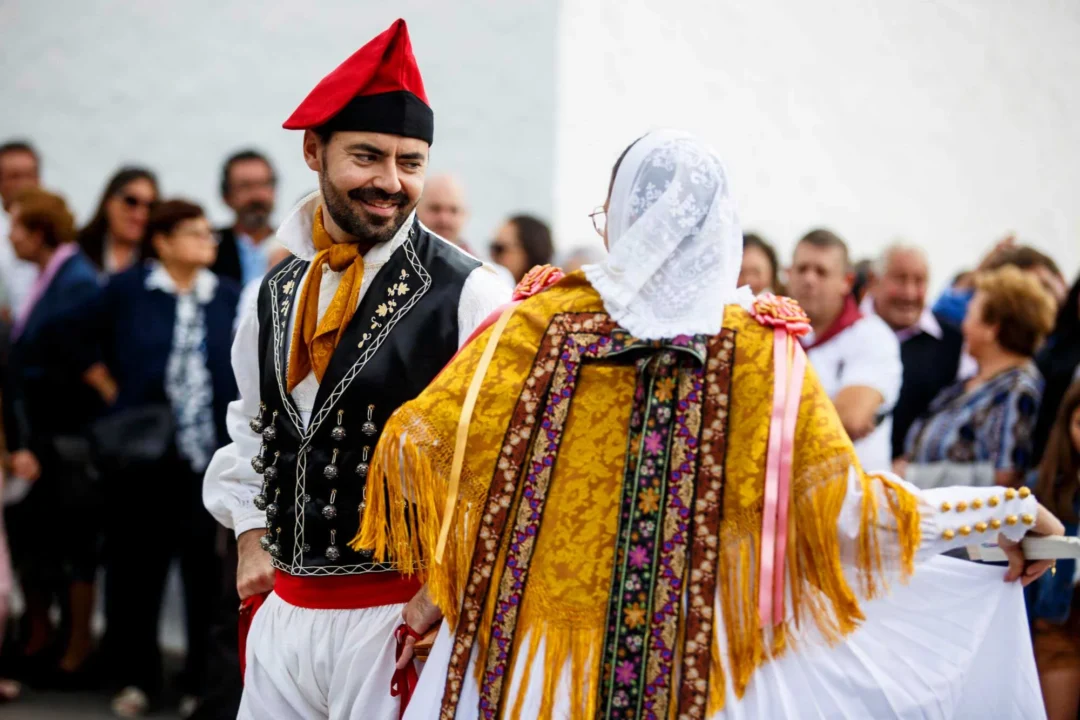
Passing traditional Ibizan dance on to a new generation
Margarita Bonet Ribas, 90, who serves as the senior churchwarden of Sant Rafel parish, shares a similar view.
“There’s more to celebrate now, and food is provided, but when I was young, many more people came, including from neighbouring villages,” she says. In those days, she adds, “there wasn’t ball pagès as there is today”.
Bonet herself helped change that. In 1981, she founded the Colla de Sant Rafel and taught its first members to dance.
Today, the folk group has a new generation of performers, including many children who have joined in recent years. Several are taking part in Saturday’s celebrations, among them siblings Inés and Enzo, who have been members of the colla for six years, according to their grandmother, Pepita Roselló.
Eleven-year-old Inés is wearing a new pair of espardenyes, traditional footwear. Other elements of her costume, however, have a much longer history. Her shawl and emprendada — a traditional set of jewellery worn with Ibizan dress — belonged to her great-grandmother Francisca. The headscarves worn by Inés and her brother also came from their great-grandmother.
A church porch decorated with symbols from the Book of Tobit
The crowd filling the church is struck by the elaborate plant-based decoration framing the entrance to the porch. The display features two pumpkins and images of two fish, and the church is packed to capacity.
“It was inspired by the Book of Tobit,” explains Berta Grajales, one of the people who helped create the display. The idea came from the village priest, José Alexander Quintero.
The religious service begins on time, accompanied by the parish choir, directed by Elena Prokhorova, who also plays the organ.
From the opening moments of Mass, attention turns to the 20 martyrs from Ibiza and Formentera who were killed at the beginning of the Spanish Civil War and beatified on 17 October.
The bishop specifically remembers the four priests who served in Sant Rafel, paying particular tribute to José Ramón Escandell, who “was the parish priest”.
The current parish priest takes the opportunity to thank Sara Ramón, Ibiza’s councillor for Culture, Education and Heritage, who is attending the service, for her financial contribution towards a series of long-awaited improvements to the church.
These include repairs to the ruined livestock enclosures, part of the old stone-paved path and the wooden roof over the porch. Funding has also supported the restoration of the historic funeral cart, which is displayed in an adjoining part of the church complex.
The Mass concludes with José Alexander Quintero’s cry of “Visca Sant Rafel!” — Long live Sant Rafel! — followed by the Himne a l’Arcàngel Sant Rafel, the hymn to Saint Raphael the Archangel, with lyrics by Josep Planells, known as Pep Negre, and music by Adolfo Villalonga.
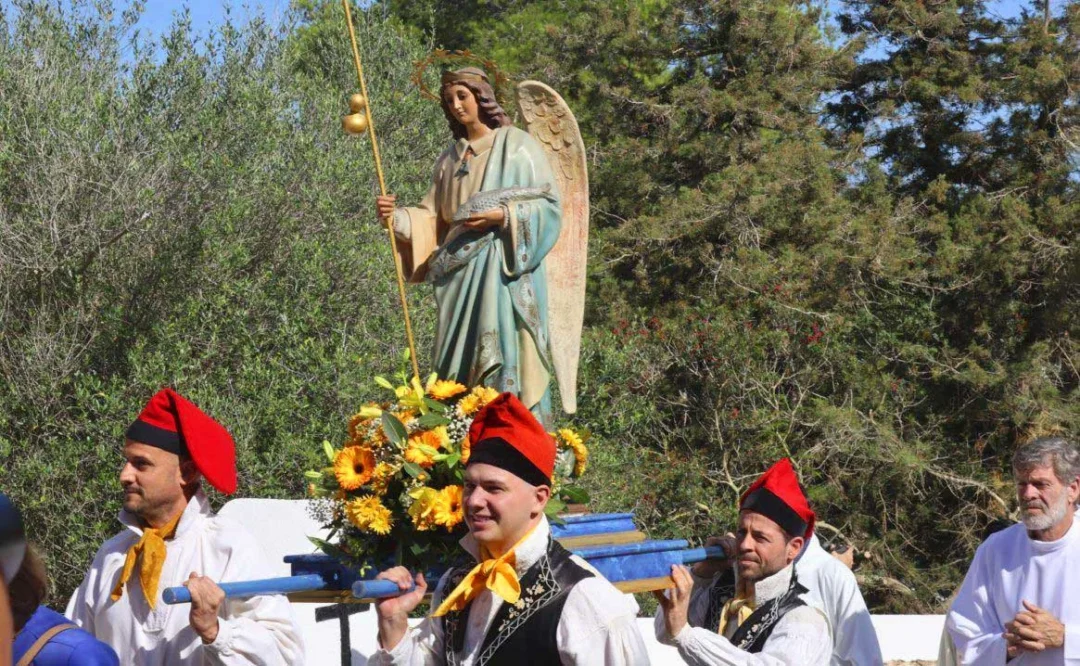
Procession, traditional bell-ringing and a gathering of local officials
As the religious images are carried out in procession, Pepe, a churchwarden from Sant Josep, rings the parish bell by hand. He performed the same task the previous year to mark the 125th anniversary of the bell, which was made by a Barcelona craftsman.
Crowds gather outside the church to watch the procession of local and island-wide officials. Those attending include Sant Antoni mayor Marcos Serra, much of the municipal council, representatives of the Consell Insular d’Eivissa and other island councils, the Balearic Government’s director-general for Emergencies, Pablo Gárriz, and regional MPs.
“It’s obvious there are elections coming up — all the parties are here,” a group of female parishioners can be heard whispering shortly before the ball pagès performance begins.
The remark adds a touch of political observation to a day otherwise centred on faith, family, community and the preservation of Ibiza’s traditional culture.