Two masses mark the main religious celebration
The village of Jesús, in Santa Eulària des Riu, Ibiza, celebrated its main festival with a full programme combining religious ceremonies, traditional culture and activities for residents and visitors.
The day’s religious celebrations included two masses. The first took place early in the morning and was led by parish priest Fernando Jesús Bayón Plaza, while the second, held at midday, was presided over by the Bishop of Ibiza and Formentera, Vicent Ribas.
The first service attracted the village’s early risers. Before entering the church, several parishioners discussed the recent deaths of migrants arriving by boat, with one resident referring sadly to “two minors and a woman.”
Inside the church, the focus soon turned to the intense heat, even before 9 a.m. Fans were switched on from the ceiling as the service began.
The mass centred on the Mare de Déu de Jesús (Our Lady of Jesús) and on remembering deceased members of the local community, whom the parish priest said had “gone to paradise.”
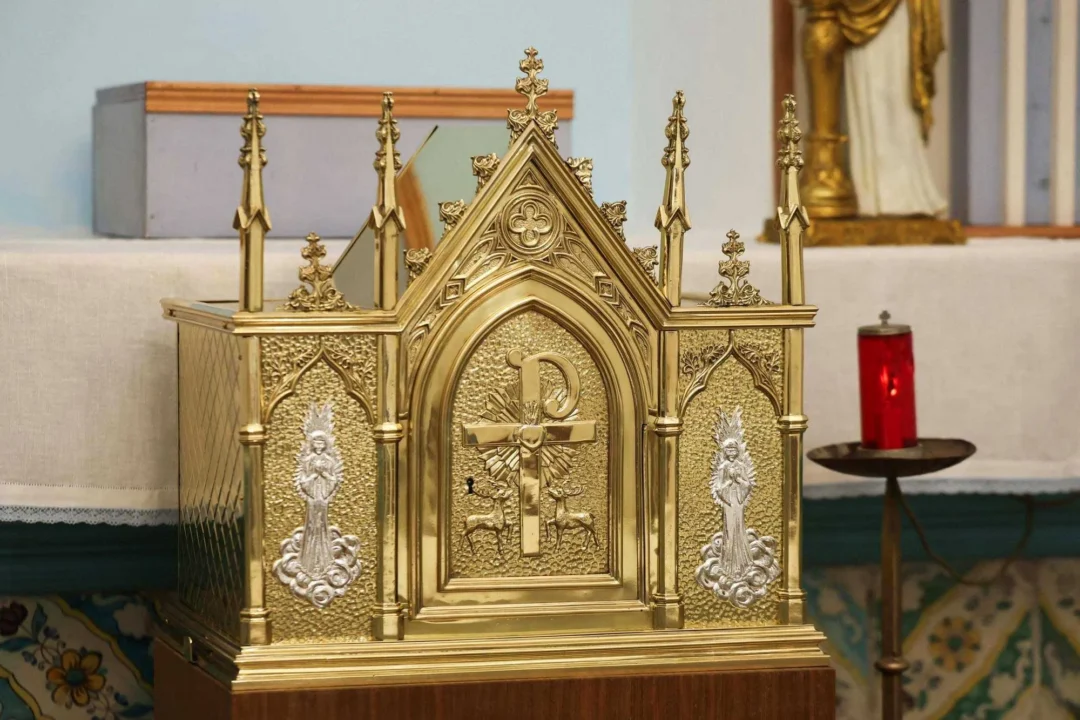
A newly restored tabernacle takes centre stage
One of the day’s highlights was the presentation of a newly restored tabernacle, which was due to be blessed by Bishop Vicent Ribas.
Bayón announced the restoration shortly before the ceremony, explaining that the work had been carried out by Valencian goldsmith Vicente David. The parish priest described the result as “exquisite”, an assessment shared by the early-morning worshippers who approached the tabernacle to admire its restored golden finish.
Bayón later thanked everyone who had contributed financially to the restoration, stressing that “it is a job we have all done together.”
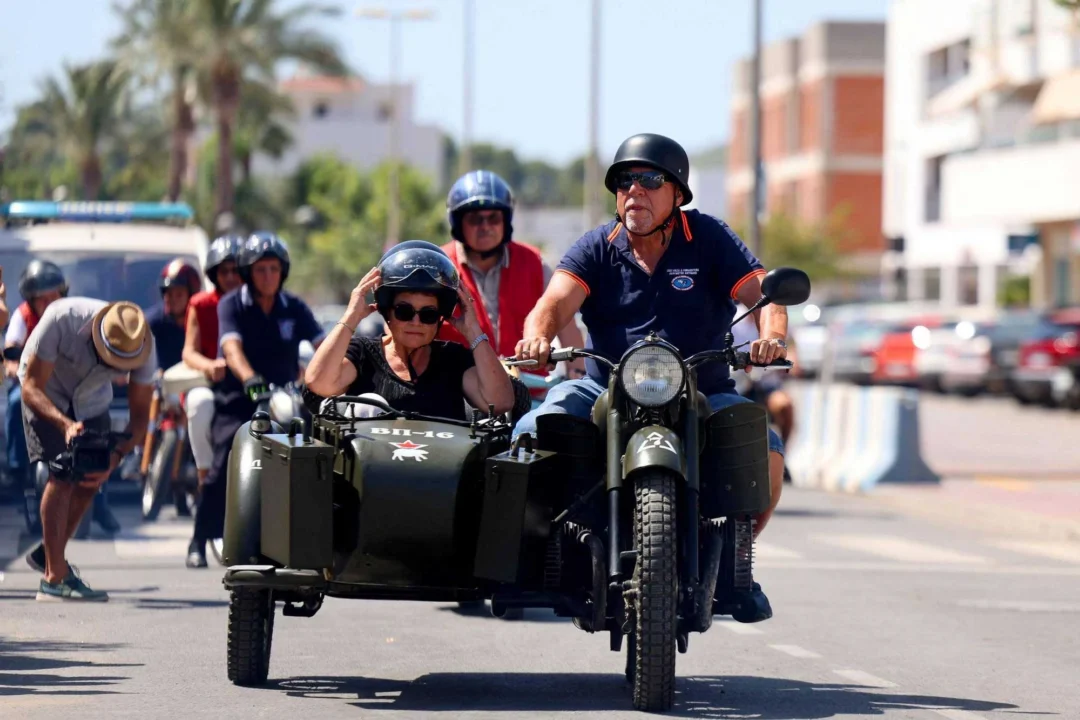
Vintage motorcycles bring a different kind of spectacle
Between the two masses, the pace of the festivities slowed before the arrival of a collection of classic motorcycles transformed the atmosphere around the church square.
Children played table tennis while teenagers sat in the shade looking at their phones. The sound of approaching engines soon caught their attention.
Among the motorcycles on display were a forest-green Vespa Socio, a sky-blue Vespa 150 and several Chang Jiang motorcycles with sidecars in different colours.
The small exhibition was organised with the participation of the Club de la Moto Clàssica d’Eivissa i Formentera, bringing models rarely seen on Ibiza’s roads into the heart of Jesús.
José Sirvent, one of the motorcycle owners, explained that his Chang Jiang is a replica of a BMW model produced during wartime. He had arrived with his wife, Gori Gràcia, riding in the sidecar.
For the couple, their motorcycles are part of a family legacy. Each has bought their own classic bike, Sirvent explained, describing them as a passion they hope to eventually pass on to their children.
The couple regularly take their motorcycles to exhibitions and village festivals.
Gràcia joked that they are now trying to encourage their children to get involved. She recalled that Sirvent arrived in Ibiza in 1977 and she followed in 1979. They originally planned to stay for just one year.
“We came saying we would stay for a year, and here we still are,” she said, adding that she believes Santa Eulària has now adopted them.
The Bishop’s mass draws a packed church
The second mass attracted a much larger crowd than the early service. Every pew was occupied before the ceremony began, and by around 11:30 a.m. additional folding chairs were being brought out.
The local authorities carefully organised the seating arrangements, with farmers and traditional representatives occupying the first pews on one side and politicians and institutional representatives seated on the other.
Councillors, members of the island’s political institutions, Balearic MPs, the Director General of Tourism, representatives of different political parties, and members of the Spanish National Police and Civil Guard attended the ceremony.
They were followed by members of the colla de ball pagès, Ibiza’s traditional folk-dance groups, as well as Santa Eulària mayor Carmen Ferrer and Consell de Ibiza president Vicent Marí.
The religious procession then entered the church, with Bishop Vicent Ribas at its centre.
Ribas thanked the parish community during his address and joked about the month-long celebrations that had already taken place in Jesús.
After midday, communion was given to the congregation, with a long queue of worshippers forming inside the church.
Music, ball pagès and a traditional procession
Music played an important role throughout the mass. Leila Foroni, a member of the Cor des Pla de Jesús choir, performed alongside the organ and piano, as well as the sonadors—traditional musicians from Sa Colla de l’Horta.
The musical programme included religious pieces such as “Senyor Tengueu Pietat”, “Ave Maria”, “Gloria”, “Pare Nostre” and “Anyell de Déu”, as well as “For the Beauty of the Earth” and the traditional song dedicated to Our Lady of Jesús, “Gotxos a Nostra Senyora de Jesús.”
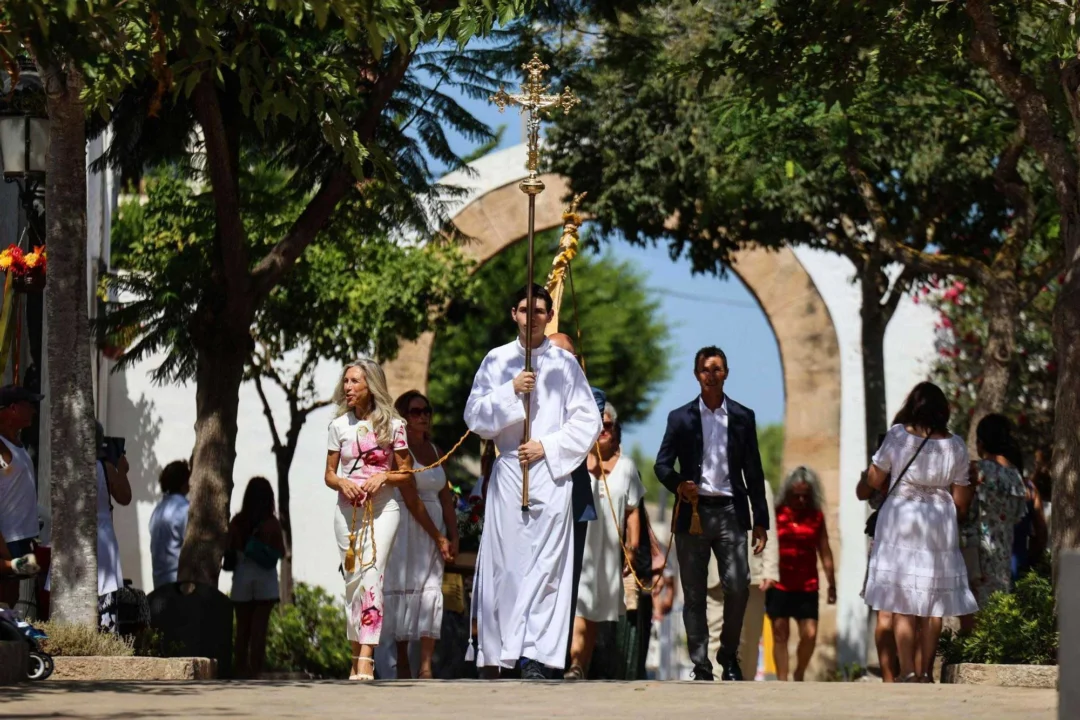
After the mass, the celebration moved outdoors for a procession around the church.
The Christian cross led the procession, followed by Vicent Marí carrying the parish flag with Carmen Ferrer at his side. Images of Jesus and the Virgin Mary were then carried by local politicians and farmers.
When the procession returned to the church square, the traditional ball pagès began.
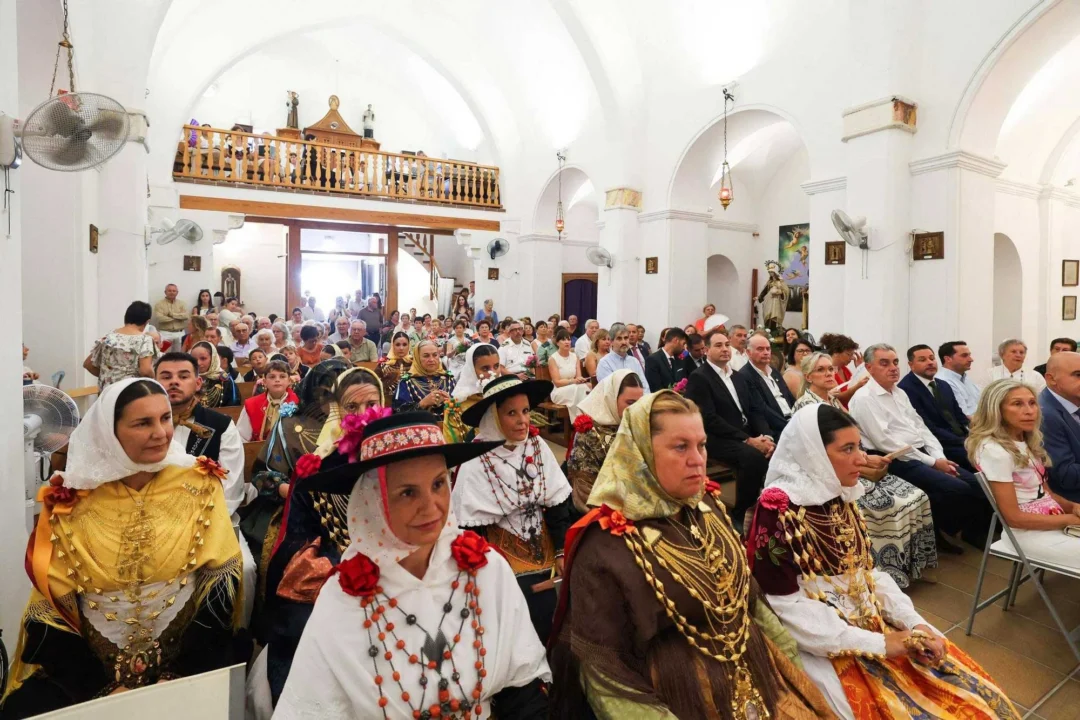
Ibiza’s traditional dance brings generations together
Children, young people and adults took part in the traditional dances, wearing elaborate local costumes and layers of traditional clothing. Cascabels rang with every jump, while the dancers’ emprendades—traditional Ibicencan jewellery—sparkled in the sunlight.
Toni Pou, a member of Sa Colla de l’Horta, explained that he began dancing at the age of 13. The group now has around 40 to 50 members, whom he describes as one large family.
Pou believes that ball pagès is more popular among young people today than it was a decade ago, although he warns that interest and knowledge do not always go hand in hand.
“We have to be very clear about where we come from, how things were done in the past and how we are doing them today,” he says.
Pou also points out that ball pagès was traditionally a “ball de festeig”, or courtship dance, among young people. For older generations, he says, it has become a way of preserving and presenting their traditional customs.
For that reason, he believes it is particularly important for younger generations to continue taking part in the tradition.
Orelletes and horse-drawn carts bring the celebrations to a close
The day’s festivities eventually moved towards the junction of Carrer Faisà and the main road, where around half a dozen horse-drawn carts were waiting.
Before the final part of the celebrations, traditional orelletes, a typical Ibicencan sweet, were handed out to those gathered in the square.
With music, traditional dance, vintage motorcycles, local food and the procession of carts, Jesús brought its main festival to a close with a celebration of faith, community and Ibiza’s cultural heritage—a true dia per fer poble, or “a day for bringing the village together.”