The second and final Nit del Patrimoni brings residents and visitors into Ibiza’s historic quarter
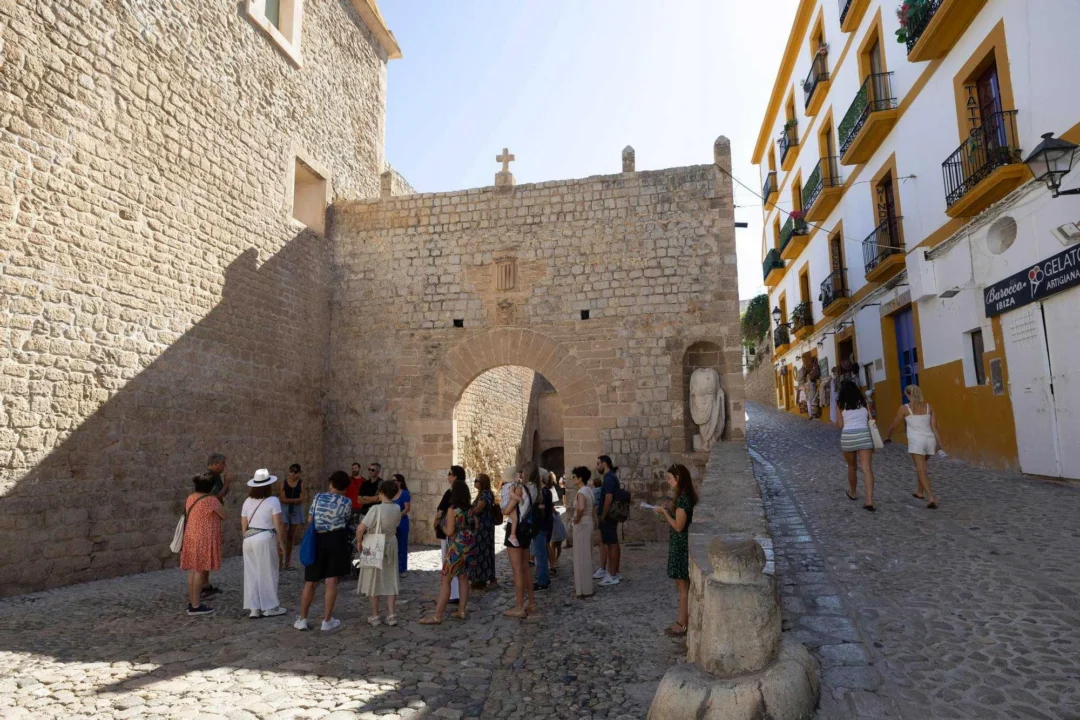
Just over 20 people from different parts of Ibiza gathered next to the Mercat Vell waiting for a theatrical tour of Dalt Vila to begin. It was one of the morning activities scheduled as part of the Nit del Patrimoni, an initiative that this year was extended to two days and concludes on Saturday night.
Among those waiting was María Luisa Cipriani, who had been looking forward to taking part in the activity.
“I’ve been wanting to sign up for this for a long time, and I’m really excited because I absolutely love Dalt Vila,” she said.
Cipriani, an Italian woman who has lived on the island for 42 years, regularly visits the walled city. She says she has visited all the museums in Ibiza’s old town and has gained a detailed knowledge of the island’s history through years of reading and research.
But not everyone living in Ibiza knows its historic heart so well.
“There are many young people who live in other municipalities who have never visited Dalt Vila,” says Graciela Sáenz.
For that reason, Sáenz says she particularly values initiatives such as the Nits del Patrimoni, arguing that more events of this kind should be organised to help both residents and tourists discover Ibiza’s cultural heritage.
She has already made the most of this year’s programme.
“On Friday I went to the saxophone ensemble concert at the viewpoint in Plaça de Espanya, and tonight I’m going to the guided tour at MACE,” she says.
Like Cipriani, Sáenz is originally from mainland Spain and has lived in Vila for almost 30 years. She enjoys walking around the historic centre both in summer and winter.
In her view, Dalt Vila has changed considerably for the better during that time, although there is still room for improvement.
“Dalt Vila has improved a lot over the years, but there are still places where you feel uneasy about going in,” she says.
She also points to the need for better maintenance in parts of the city.
“There needs to be more cleaning, especially in La Marina, where there are many façades that are embarrassing,” she adds.
Isabel Barberà, meanwhile, is attending her first theatrical tour of Dalt Vila. She says she loves getting lost among its streets and believes cultural initiatives such as the Nits del Patrimoni should be organised more frequently.
“These kinds of events should be held often, especially in winter,” she says.
Her comments come shortly before Carmen Domínguez welcomes the participants and introduces the activity.
A “very positive” response to this year’s programme
Vila’s Councillor for Culture highlights what she describes as the very positive response to this year’s edition.
“The overall balance is very positive. The three concerts on Friday attracted a large audience, and the guided tours held that day at the Arxiu Històric d’Eivissa i Formentera, the Museu Puget and the ‘A Night on the Walls of Dalt Vila’ activity organised by the Madina Yabisa interpretation centre were also a success,” she says.
The theatrical tour about to begin is directed by Neus Torres. She explains that the story being brought to life by actors Miquel Vingut, Inma Ferrà and Ignasi Roselló is set in the 16th century, when Ibiza’s Renaissance fortifications were constructed.
The play was written by local historian Antoni Ferrer Abárzuza.
Official guide Carlos Espín Tribes provides the historical context to the romantic story, which is mixed with humour and centres on Pere Francolí, a knight and lord of Can Comasema Palace — now home to the Museu Puget — and Elisabet Tur, the daughter of a boatbuilder.
While the theatrical tour gets underway, another activity scheduled at the same time in the cloister of Ibiza Town Hall has to be cancelled because nobody turns up.
It is an unfortunate outcome for an original proposal by Adrián Herrera, a dancer, choreographer and specialist in marine fauna and ecology.
“This body-research workshop comes from a personal project in which I study and work with the parameters of how marine invertebrates activate their muscular systems, including animals such as octopuses, jellyfish and anemones,” Herrera explains.
However, audiences will still have the opportunity to see one of his creations, ‘Benthos’, in two performances on Saturday night.
The dancer and choreographer from Mérida describes the work as an exploration of posidonia seagrass as a living organism, an ecological archive and a metaphor for the collective body, expressed through contemporary dance.
Art, music and dance inside Ibiza’s historic walls
Beyond turning Dalt Vila into a stage for different artistic disciplines, one of the main objectives of the Nits del Patrimoni is to encourage audiences to explore the museums and exhibition spaces located throughout Ibiza’s historic quarter.
At midday, visitor numbers to these cultural venues appear to be broadly similar to those of an ordinary weekend. However, organisers expect the extended afternoon and evening opening hours to attract more visitors once temperatures become more comfortable.
At Espai Cultural Es Polvorí, home to the Ibiza Art Fair, visitors — particularly international tourists — arrive steadily to explore the eclectic exhibition curated by Adriana Peterova.
The exhibition brings together galleries and independent artists, including two of the featured creators who are present at the venue to discuss their work with visitors.
One of them is Roberto Mellino, who enthusiastically explains his distinctive artistic approach.
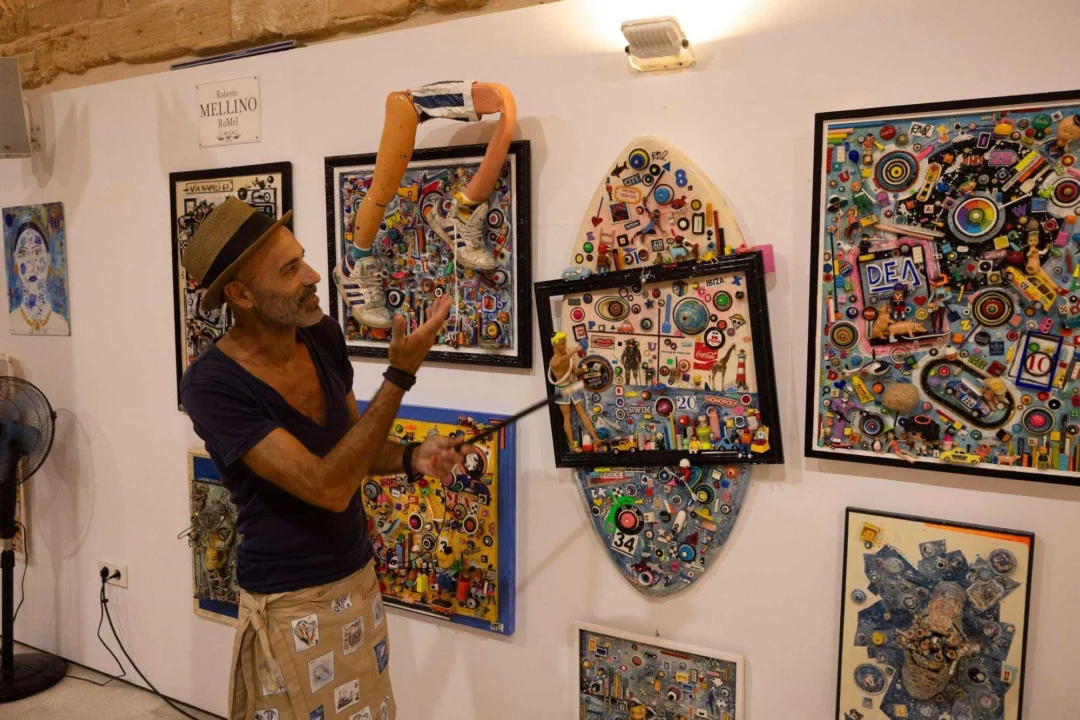
His wall sculptures are made from recycled objects collected from different places and explore themes including the passage of time and his view of “how the world is going”. Judging by some of his work, that world appears to be heading in the wrong direction.
Trump, Netanyahu and Maradona are among the figures appearing in his pieces, which combine imagination with political and social criticism.
On the other side of the room, Ákos Burg presents a series of photographs created without AI or Photoshop.
The minimalist photographer says that elegance and hair are two recurring themes in his work.
“My models are ordinary people because I’m looking for natural beauty,” he explains.
MACE invites visitors to experience art “slowly”
At the Museu d’Art Contemporani d’Eivissa (MACE), director Elena Ruiz Sastre is putting the finishing touches to the script for the evening’s guided experience of Cel d’Or, the temporary exhibition by conceptual artist Stefan Brüggemann.
Ruiz Sastre wants to move away from the conventional museum tour and offer visitors a different way of engaging with the exhibition.
Her idea is to encourage a conscious and slow approach to the artworks, allowing visitors to focus on what is directly in front of them rather than trying to process everything at once.
She also wants to prevent visitors from becoming frustrated by feeling that they have to understand every piece.
Instead, she encourages them to experience Cel d’Or “as if it were a landscape.”
As she speaks, a couple of tourists, Alina Ivanova and César Zamora, enter the Sala de Armas. They photograph the works and take their time looking at the pieces by the Mexican conceptual artist.
Ivanova is particularly impressed by Brüggemann’s work. In fact, the couple came to MACE specifically to see his exhibition, although they have also been fascinated by the museum’s permanent collection.
Yet there is an unexpected detail: neither of them knows that Saturday is part of Nit del Patrimoni.
And they are also unaware that Dalt Vila is a UNESCO World Heritage Site.
That encounter perhaps captures one of the central challenges facing Ibiza’s heritage events: the island has an extraordinary cultural legacy, but making that heritage visible and meaningful to residents, younger generations and visitors remains an ongoing task.