The aerial treatments will begin next week and continue through October and November, with two applications planned over the woodland areas most affected by the pest.
The Balearic government will launch a new campaign of aerial treatments against the pine processionary moth in Ibiza and Formentera next week, targeting 15,000 hectares of forest. It is the third consecutive year that the regional Department of Agriculture, Fisheries and the Natural Environment has used aerial spraying to control the insect population, curb its spread and reduce the damage it causes to pine forests across the Pityusic Islands.
The campaign, which will run throughout October and November, includes two passes by aircraft and helicopters over 12,500 hectares in Ibiza and 2,500 hectares in Formentera.
Operations will focus particularly on southern and north-western Ibiza, where some of the most heavily affected woodland areas are located, while also covering Formentera. The exact dates of the treatments will depend on weather conditions.
The total budget allocated to pine processionary moth control measures planned for 2026 amounts to €2.76 million.
Joan Simonet, the Balearic regional minister for Agriculture, Fisheries and the Natural Environment, has stressed the importance of maintaining ongoing monitoring and control programmes.
“The pine processionary moth is an insect that requires continuous monitoring, both because of its potential impact on forest areas and the problems it can cause for people and animals,” he said.
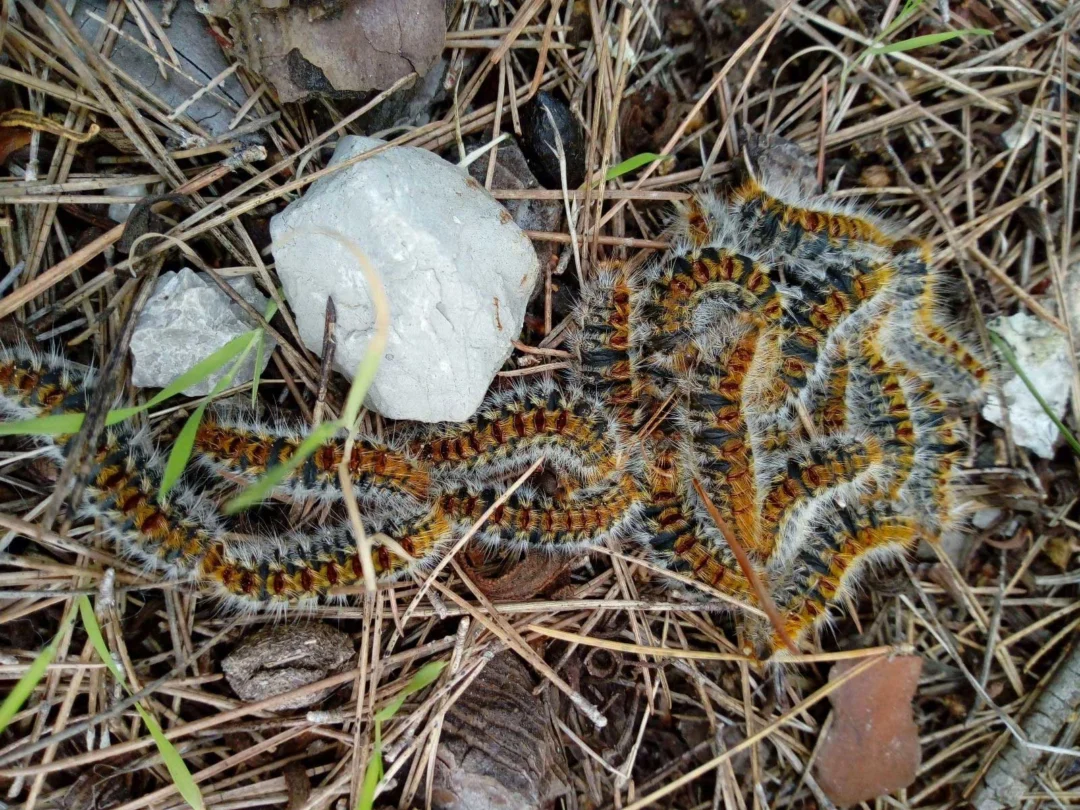
Simonet also warned of the risks posed by the caterpillars. Their urticating hairs can trigger allergic reactions and respiratory problems, particularly in pets such as dogs. He therefore advised people to avoid touching or handling the insects.
The department estimates that around 25,000 hectares of pine forest in Ibiza could potentially be affected by the pest. Although the damage recorded so far remains relatively limited, the insect population has increased in recent years in areas outside the original outbreak zone, which was declared in the north-east of the island in 2021.
The situation in Formentera is different. Around 2,500 hectares of pine forest could potentially be affected, but monitoring has recorded a reduction in infestation levels over the past two years.
A biological treatment approved for organic farming
As in previous campaigns, the aerial operations will use Bacillus thuringiensis var. kurstaki, a biological product derived from a bacterium naturally found in soil and on plants that acts against pine processionary caterpillars.
The product remains on leaves for only a few days, as it breaks down quickly under ultraviolet light. It does not affect bees and is authorised for use in organic farming.
Aerial spraying will be complemented by ground-based treatments using mist-blower equipment. The Forest Health Service has two such units, one of which is based in the Pityusic Islands.
These operations are generally carried out between mid-October and late November, with two applications on separate, non-consecutive days using the same biological product.
Nearly 30,000 adult moths caught in Ibiza
The control programme also includes pheromone traps, the removal of caterpillar nests and measures to encourage the presence of natural predators.
During the summer of 2026, a total of 2,760 pheromone traps were installed across the Pityusic Islands: 1,271 in Ibiza and 1,489 in Formentera. The devices are fitted with protective covers to prevent other animals, particularly lizards, from entering. They are checked four times during the campaign.
Figures from the third inspection recorded 29,838 male pine processionary moths caught in Ibiza, with a further 3,923 in Formentera.
Another key measure involves removing the characteristic silk nests from affected trees. Between January and March this year, 18,744 nests were removed across the two islands: 8,893 in Ibiza and 9,851 in Formentera.
The figures show contrasting trends compared with the same period in 2025. In Ibiza, the number of nests removed fell from 15,539 to 8,893. In Formentera, however, it rose from 6,332 to 9,851.
Nest boxes to encourage natural predators
The Balearic government is also continuing its biological control measures by installing nest boxes for insect-eating birds and roosting boxes for bats, with the aim of encouraging species that feed on these insects.
Formentera currently has 89 bat roosting boxes, while Ibiza has 105 bat boxes and 187 nest boxes for insectivorous birds.
These measures are complemented by efforts to control the pest using parasitoids that attack pine processionary moth eggs. This approach has been studied by the University of the Balearic Islands (UIB) and is currently being developed by Tragsa.