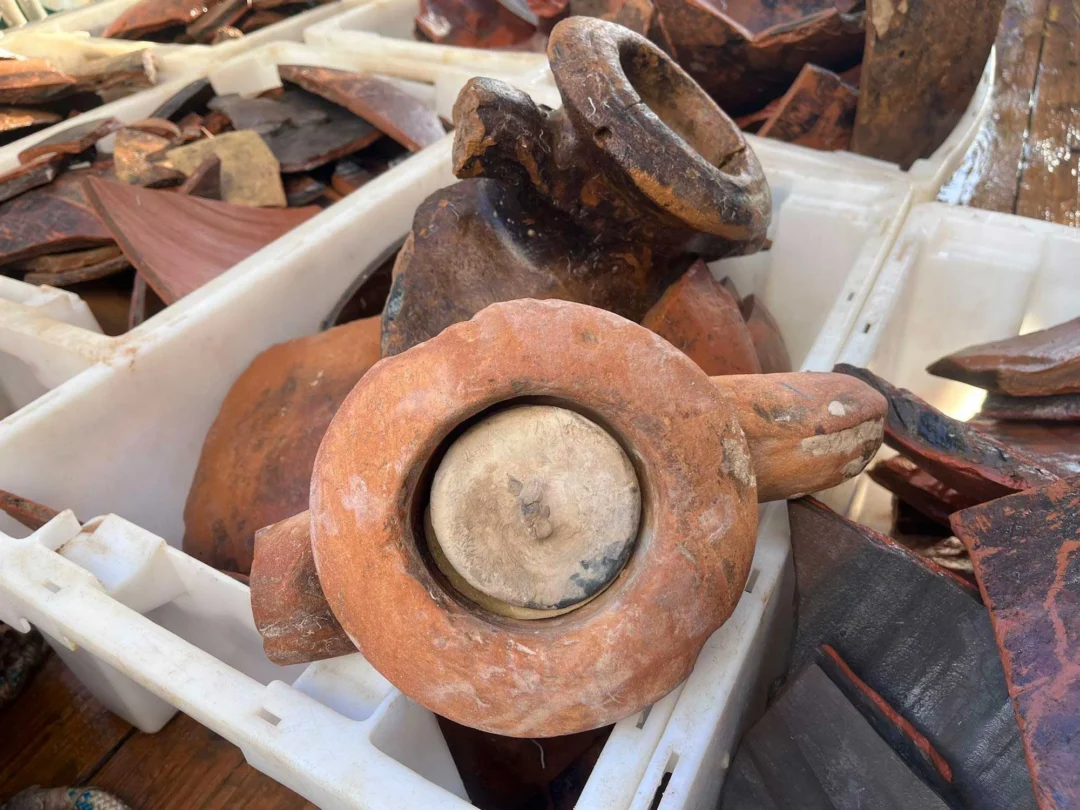
The Ibiza and Formentera Archaeological Museum (MAEF) has taken custody of a remarkable collection of approximately 26 Roman amphorae and 17 boxes of fragmented ceramic material recovered this week by the research vessel Miguel Oliver in waters south of Formentera.
The artefacts were found by chance at an archaeological site located around 1,400 metres beneath the Mediterranean Sea, making the discovery particularly significant from both an archaeological and conservation perspective.
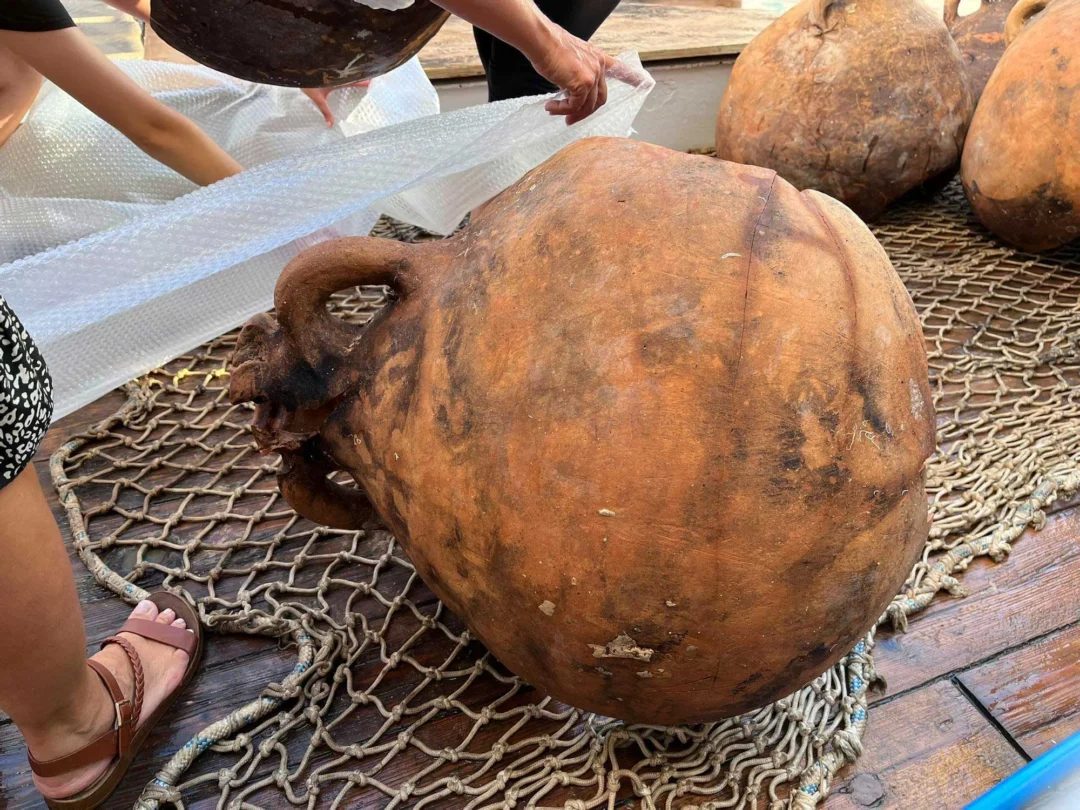
The material is relatively uniform in typological terms and consists mainly of Dressel 20 Roman amphorae, large vessels traditionally used to transport olive oil throughout the Roman world.
The recovered pieces also bear numerous stamps and markings, which experts expect will provide valuable information once the material undergoes detailed archaeological study.
Discovery made during an international Mediterranean research campaign
The archaeological material was recovered while the Miguel Oliver was taking part in the MedITS campaign, an international oceanographic and fisheries research programme focused on assessing the condition of marine resources and ecosystems in the Mediterranean.
The campaign is coordinated by the Spanish Institute of Oceanography (IEO-CSIC) together with Spain’s Ministry of Agriculture, Fisheries and Food.
After authorities were notified of the discovery, officials from the Balearic Islands government worked to establish exactly which jurisdictional waters the site fell within and determine how the recovered artefacts should be handled.
Once it was confirmed that the discovery had taken place in Spanish state waters, the Directorate General for Culture mobilised the MAEF team and provided the necessary resources to transport the archaeological material to the museum, according to a statement from the Balearic Islands Department of Tourism, Culture and Sport.
Museum begins desalination and conservation work
The transfer of the artefacts to the Ibiza and Formentera Archaeological Museum was authorised by Spain’s Underwater Cultural Heritage Service, which operates under the central government’s Ministry of Culture.
The decision took into account both the nature of the archaeological material and the circumstances surrounding its unexpected recovery.
The MAEF will now catalogue the artefacts, assess their condition and establish the appropriate conservation measures. Following the initial assessment, specialists will determine how the material should be stabilised and where it will ultimately be housed on a permanent basis.
Although underwater archaeological objects are considered particularly sensitive to changes in their environment, the condition of the recovered material is currently described as stable.
This was helped by the crew of the Miguel Oliver, who kept the amphorae continuously hydrated after they were brought to the surface, using a hose to ensure that the artefacts remained wet.
Once the material arrived at the museum’s storage facilities, conservation specialists began desalination and stabilisation treatments, working on the artefacts individually and placing them in specially prepared water tanks.
These initial conservation procedures are essential to prevent deterioration caused by the transition from the underwater environment to controlled storage and to prepare the pieces for future restoration and consolidation.
Conservation work will continue over the coming days
The MAEF conservation team will continue working throughout Saturday and Sunday to ensure that the artefacts remain in stable condition.
From next week, the museum plans to continue the stabilisation process, with the aim of ensuring that the archaeological material can eventually be securely stored at the museum on a permanent basis.
The long-term conservation process will also provide researchers with an opportunity to examine the amphorae and their markings in greater detail, potentially revealing new information about the production, distribution and maritime transport of Roman olive oil.
A significant discovery at an exceptional depth
The discovery of amphorae in the waters surrounding the Balearic Islands is not unusual. Formentera and its surrounding waters have produced numerous underwater archaeological finds in recent years.
However, authorities have highlighted the special significance of this particular collection because of its size, its relatively good state of preservation and, above all, its unusual origin.
The fact that the material comes from an archaeological site at a depth of 1,400 metres makes the discovery especially noteworthy.
The combination of the number of artefacts recovered, the presence of stamps and markings and the exceptional depth of the site could make the collection an important source of information for future research into Roman maritime trade and the movement of goods across the Mediterranean.
MAEF praises the crew of the Miguel Oliver
The MAEF has expressed its gratitude to the entire crew of the Miguel Oliver for recovering the artefacts and immediately notifying the relevant authorities.
That rapid response allowed the different institutions involved to coordinate the operation and arrange for the material to be received by the museum within less than 24 hours.
The Balearic Islands’ Minister for Tourism, Culture and Sport, Jaume Bauzà, also praised the response, highlighting the willingness of the regional administration and, in particular, MAEF’s technical specialists to act quickly.
According to Bauzà, their work made it possible to provide a fast and efficient conservation solution for the archaeological material recovered from the seabed.
The artefacts will now remain under specialist care while conservation and research work progresses, potentially opening a new window into the Roman economy and maritime networks of the Mediterranean.