
The Ministry of Education is already working on the design for next year in schools and institutes. It has just provided the autonomous communities, with whom it will meet tomorrow, a draft that includes a series of health and school recommendations. The measures – in which the contributions of the communities will be incorporated – will not be fully approved until Wednesday of next week, when Education and Health ministers convene.
The draft of the department headed by Isabel Celaá warns that the measures will be reviewed depending on the epidemiological situation. If herd immunity (70% of the vaccinated population) is reached by August 20, as indicated by official forecasts, it is assumed that in September the pandemic is much more controlled but not over. “The global dimension of the pandemic makes it necessary to maintain a level of caution,” explains the draft.
This prudence translates into maintaining practically the same measures that have made schools one of the few places safe from the virus this year. In all this time, the number of confined classrooms has not exceeded 2%.
The ministry wants to guarantee attendance at all levels. In the unlikely event that the pandemic were worsen, from the 3rd year of ESO onwards it would be possible to switch to semi-presence. The pod groups will be maintained, however, the support teachers that are required to maintain them is another thing. And between them there is no need to maintain the interpersonal distance of one and a half metres. These groups will have a maximum of 20 pupils in infants (where children are not obliged to wear masks) and 25 in primary school. The different primary groups will finally be able to interact together but only in outdoor activities: recreation, educational projects or sports.
Within ESO courses, there will no longer be stable coexistence groups but the desks in the classroom must maintain a distance of between 1.2 and 1.5 meters. If these distances cannot be guaranteed, one option remaining is open-air classes, either with pergolas or awnings. And if not, blended learning from 3rd year onwards.
The students of Bachillerato must also maintain the 1.2 or 1.5 meter distancing in the classrooms. The official document of the ministry recalls that the students of 2nd of Bachillerato are especially burdened with Selectividad exams, so it asks the schools for “organizational solutions” to ensure the greatest possible attendance.
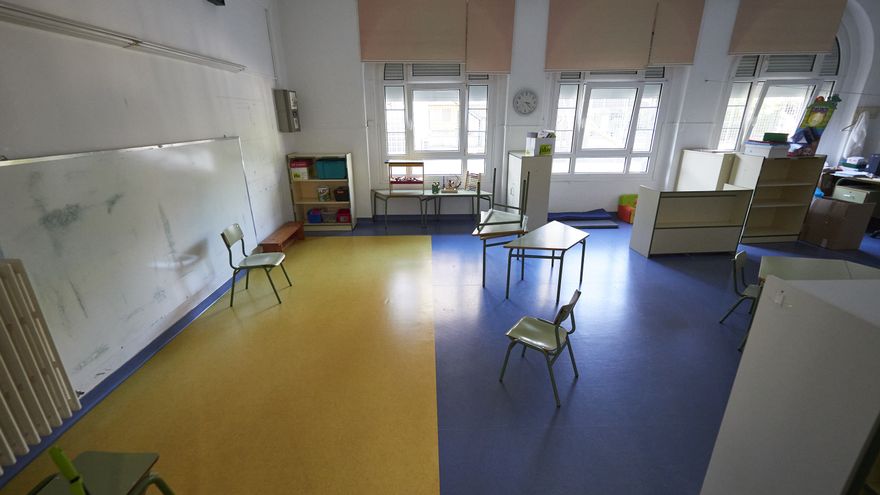
The classrooms should always be well ventilated. If possible with natural cross ventilation (windows and doors permanently open).
The Education document, which is not definitive until it incorporates the observations of the communities, urges schools to maintain this year’s Covid protocol to manage cases of children with symptoms.